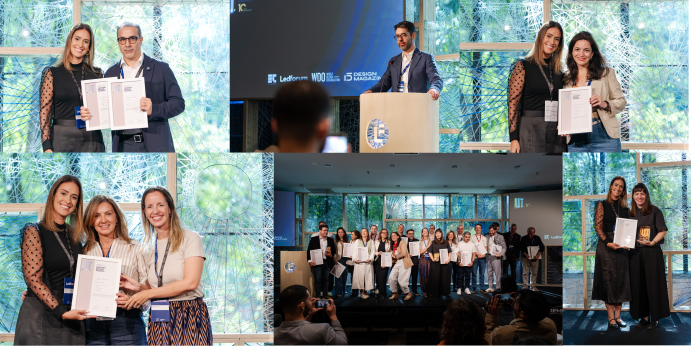
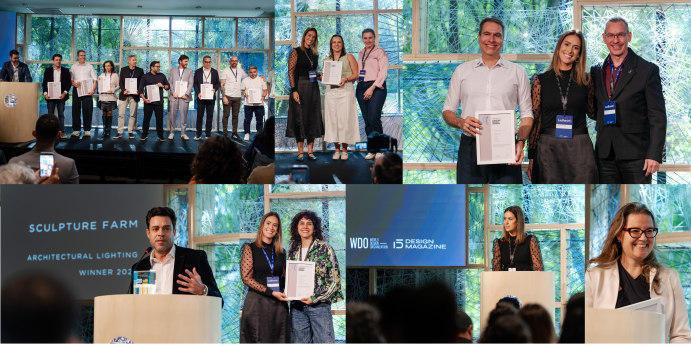
The LIT Lighting Design Awards brought its celebration of excellence in lighting design to São Paulo, Brazil, with a special winners ceremony held during LEDforum.26 on August 21 at the Tivoli Mofarrej Conference Hotel.
Recognized nationally and internationally as one of Brazil’s leading gatherings dedicated to lighting, LEDforum brings together influential voices and emerging perspectives from across the industry. Its program of lectures, discussions, and activities attracts a diverse audience of lighting designers, architects, product designers, urban planners, landscape designers, academics, developers, and lighting solution providers from across Brazil and Latin America.
Against this vibrant backdrop, the LIT Lighting Design Awards celebrated the achievements of its 2025 Brazilian and regional winners, highlighting projects and professionals whose work continues to shape the future of lighting design.
The ceremony was presided over by Camila Linhares from the LIT Lighting Design Awards, who welcomed the winning studios and designers to the stage. Among those recognized were Atiaîa Lighting Design, Cena Studio De Iluminação, Mingrone Iluminação, NTZ Lighting, Studio Fos Iluminação, Studio io Arquitetura, Studio Symbios, Welight, Dessine, Dsgnselo, and LDE LightDesign Exporlux.
The celebration also recognized this year’s Honorable Mention recipients: Arquitetura E Luz, De Riggi Arquitetura de Iluminação, Lid Light In Design (DeltArchLD and LiD – Light In Design), Alfalux Iluminação Ltda, OMEGALIGHT, and Limarí Lighting Design.
Bringing the LIT Lighting Design Awards to LEDforum.26 created an opportunity to celebrate the Brazilian and Latin American lighting community within one of the region’s most important industry gatherings. The ceremony reflected the Awards’ ongoing commitment to recognizing exceptional talent and providing an international platform for designers whose creativity, technical expertise, and vision are advancing the discipline of lighting design.
The LIT Lighting Design Awards celebrated its 10th anniversary in a lavish ceremony in the heart of Paris on June 16th, honoring the brightest achievements in Lighting Product, Architectural, and Entertainment Lighting Design across the global.
Switzerland – The LIT Lighting Design Awards celebrated its 10th anniversary this week with an evening of recognition and connection in the heart of Paris. Held at the Yachts de Paris — a venue perched along the Seine within sight of the Eiffel Tower — the ceremony brought together 200 lighting designers, jury members, and industry figures from 25 nationalities, making it a truly international gathering.
The day began with an afternoon of networking and design talks, featuring a series of concise presentations that offered an intimate insight into the concepts, innovations, and stories behind the 2024 and 2025 award-winning projects. Attendees — including winners, jury members, and press representatives — gathered along the banks of the Seine for an afternoon of exchange and connection.
This was followed by a sumptuous Awards Ceremony, which honoured the Design of the Year winners across Architectural, Entertainment, and Lighting Product Design, alongside the Emerging Designer categories and the Lifetime Achievement Award.
The 2024 Design of the Year honourees present included Saumya Monga and Zerlina Hughes of Studio ZNA for Gabrielle Chanel. Fashion Manifesto (Architectural), Takahiro Matsuo, founder of Lucent Design Inc., for The Creation (Entertainment), and Vaida Atkočaitytė-Dališanskienė, a student at Vilnius Academy of Arts, who was recognised as Emerging Lighting Product Designer of the Year for MOOD.
Suzan Tillotson, Founder and President of Tillotson Design Associates, received the 2025 Lifetime Achievement Award for her outstanding contribution to the industry. The 2025 honourees included Mariana Novaes of Atiaîa Lighting Design for Memorial Brumadinho (Architectural); Martin Döller of One to One by Martin Döller for Amphora (Lighting Product); and James Tapscott of Studio JT Pty Ltd. for Arc ZERO: Eclipse (Entertainment). The Emerging Lighting Designer of the Year award went to the Deggendorf Institute of Technology team, represented by Franziska Rieder, Sabine Wiesend, and Jannick Lippert for Flight into Shadow, while Yuxin Luo, a student at ArtCenter College of Design, was recognised as Emerging Lighting Product Designer of the Year for CinderGlow.
“Ten years ago, we started the LIT Awards with a simple belief — that lighting design deserved a platform of its own. What this anniversary edition in Paris showed us is how far that community has grown, and how deeply it cares about the power of light. To see designers from across the world come together, share their work, and celebrate each other in a city that understands beauty — that was everything we hoped this milestone would be.” — Astrid Hébert, Director of the LIT Lighting Design Awards.
The LIT Lighting Design Awards winners also included Maytoni, Hydrel, Expolight, Lichtvision Design, Artec Studio, Brandston Partnership Inc., L’Observatoire International, LELCO, Eleftheria Deko & Associates, Aslight, Sweco Architects, CD+M Lighting Design, Light Directions, and NEAL Lighting, alongside leading French lighting firms such as Concepto, Light is More, and Projetscénie, among others.
The evening closed with a seated gala dinner, with each attending winner called to the stage to receive their commemorative anniversary trophy — a moment that captured both the personal significance of the recognition and the collective spirit of an industry.
On June 16, 2026, the LIT Lighting Design Awards will celebrate its 10th anniversary in the heart of Paris. This milestone event promises to be a perfect blend of innovation, creativity, and networking, set against the iconic backdrop of the Seine River and the Eiffel Tower.
Event Highlights
The day is set to begin with a vibrant networking session featuring Fire Talks and Snapshot Presentations that will showcase the award-winning projects from the past two years. Attendees can expect a welcome coffee followed by dynamic presentations, offering insights into the creativity and concepts behind the designs. This relaxed atmosphere will foster meaningful connections among professionals, designers, and peers.
Awards Ceremony
As evening falls, the spotlight will turn to the distinguished Awards Ceremony and Gala Dinner at the elegant Yachts de Paris, Salon Nework. The ceremony will honor the exceptional talents of the winners from 2024 and 2025, with heartfelt presentations of each project. Winners will be called to the stage to receive their commemorative trophies, creating unforgettable moments filled with pride and recognition.
With the presence of distinguished judges and influential figures from the design world, this event will offer an unparalleled platform for recognition, networking opportunities and exposure. The LIT Lighting Design Awards will continue to shine as a platform that recognizes and celebrates the art and science of lighting design. With the presence of industry leaders and a commitment to fostering creativity, the event promises not only recognition but also inspiration for the future of lighting design.
The LIT Lighting Design Awards 2025 Winners Catalogue is now available, showcasing the most outstanding and innovative lighting projects from around the world. This year’s publication highlights exceptional achievements in architectural, entertainment, and product lighting, recognizing the visionary designers who are shaping the future of the industry.
In addition to the award-winning projects, the catalogue features exclusive interviews with the “Designers of the Year” and “Emerging Designers of the Year”, offering valuable insights into their creative processes and perspectives on the evolving field of lighting design.
The catalogue is available to purchase on Amazon and can be downloaded on the LIT Awards website.
The Memorial Brumadinho is a place of remembrance and symbolic reparation, created to honor the 272 victims of the 2019 dam collapse in Brumadinho, Brazil. Conceived as a sequence of architectural, landscape, and exhibition spaces, the memorial invites visitors into a slow, introspective journey shaped by silence, materiality, and light.
The project received the Architectural Lighting Design award at the LIT Lighting Design Awards, recognizing the work of Atiaîa Lighting Design for its sensitive and conceptually rigorous approach. Rather than acting as a visual statement, the lighting design operates as a subtle guide, reinforcing architectural meaning while symbolizing presence, absence, and collective memory.
Led by lighting designer Mariana Novaes, founder of Atiaîa Lighting Design, the project demonstrates how architectural lighting can extend beyond aesthetics to engage with ethical responsibility, environmental care, and emotional experience. In our interview, Mariana shares insights into the design process, the challenges of lighting a space marked by loss, and the role of light as a medium for remembrance and transformation.
Memorial Brumadinho. Photo Credits: Pedro Mascaro // Mariana Novaes by Lucas de Godoy
Can you tell us about your background as a designer and what inspired you to start your own studio, Atiaîa Lighting Design, back in 2016?
I graduated as an architect and urban planner, and even in college, I understood that I wanted to focus on lighting. The work of great masters, such as Louis Kahn, Alvar Aalto, Peter Zumthor, Lina Bo Bardi, among others, made my eyes shine. I always understood architecture as the first outer layer, beyond our body, that influences our well-being, where light is a fundamental aspect of this. At that time, the technological revolution caused by LED technology was gaining momentum, and research on the impacts of light on our health was beginning to be disseminated, which soon caught my attention, making me interested in learning more about the subject.
Before doing my master’s in Architectural Lighting Design at KTH, I completed a postgraduate degree in ergonomics, which has many principles integrated into Atiaîa’s work methodology. After a seven-year period away from Belo Horizonte, my hometown, studying in Sweden and working on lighting studios in Rio de Janeiro and Singapore, I really wanted to return “home.”
Atiaîa emerged after a previous partnership fell through. I was already in Belo Horizonte and understood that there was a good reception for the service in Minas Gerais and Brazil. That’s when I saw the opportunity to become an entrepreneur as a way to apply what I believe in, based on everything I had been searching for, learning, and processing as relevant: projects that take the user experience as their starting point and contribute to their well-being as a result; consideration of visual, biological, and psychological aspects; inspiration from light phenomena and urban, social, economic, and cultural contexts; in-depth technical, technological, and aesthetic solutions; meticulous attention to detail; research-based work; close collaboration with clients, suppliers, design and engineering disciplines; and the pursuit of excellence.
Atiaîa is a word from the Tupi-Guarani language meaning a ray of light, which reflects luminosity. These qualities are sought daily in our professional practice and conduct.
How did the tragic history behind Brumadinho shape your vision for the memorial’s lighting from the very beginning?
I remember watching the news about the Brumadinho dam collapse on TV at lunchtime, in disbelief, just over two years after the Mariana dam collapse, which had already been shocking enough. My feeling was one of great outrage. I couldn’t comprehend how, in such a short time, such absurdity was happening again and so close by, here in Minas Gerais. I wondered: hadn’t the previous collapse taught us anything? What else was needed for there to be more respect for lives, for the environment? And then we learned more news and information, even worse, about the tragedy. It was unbelievable…
Some time later, the architect Laura Penna called me, inviting me to join the project team. I knew it was being carefully chosen and that the synergy found in previous projects with GPAA had created a lot of trust between us. I felt very honored to take on this commitment with her.
The first time I saw the project developed by Gustavo’s office, I was deeply moved and felt the profound respect dedicated to the victims’ families. Beyond respect, values such as humility and care were premises for the development and implementation of the entire project.
Developing the lighting design wasn’t just about my vision. Before that, there were feelings and perspectives of the victims’ families and how architecture transformed them into a solemn space against oblivion, for collective reflection.
In my mind, since I learned about the tragedy and read the architectural project, I could only think about lighting a candle, this gesture of tribute, remembrance and consideration, so ancient and present in many cultures. The glow of the flame symbolizes the presence, in memory, of those remembered, while simultaneously illuminating and comforting those who light it. This is what I wanted to convey with the lighting design.
How did you use light to make the experience more immersive for visitors, not just visually but also on an emotional level?
The presence of light guides the eye, highlights architectural elements such as materials, details, and the space itself. It reveals messages and symbols. But its absence invites pause, reflection, and introspection.
I believe it is the balance between light and darkness, where there are contrasts and gradients, that allows these symbols and meanings to be striking.
The light distribution, the dosage of intensities and quantity of light, the choice of color temperature, and where light falls were some of the strategies used to create the Memorial’s atmosphere.
Visiting it during the day and at night are distinct but complementary experiences – equally moving and important. Visual experiences create meanings as well as feelings. Individually, each person experiences the Memorial in their own way.
Memorial Brumadinho. Photo Credits: Pedro Mascaro
Could you share how you used light to reveal or emphasize specific architectural gestures in the memorial?
We interpret and attribute meaning and significance to what we see and experience. Therefore, nothing is better than inviting our gaze to perceive the interaction between light and materials, and our bodies to feel its impact on space and on our experience.
For example, the entire architecture of the Memorial is made of concrete mixed with pigment from mining waste. The Entrance Pavilion confronts the visitor with the brutality of the tragedy. Its front facade has fragmented blank planes, illuminated by grazing uplighting solutions, drawing attention to the texture and color of the concrete. The amount of light is not bothersome, but striking, highlighting the transition between the exterior and interior, indicating a solemn space and emphasizing the contrast with the interior of the entrance hall. This hall features small openings in the ceiling and large planes of pigmented concrete. The darkness invites reflection on the shock of the dam rupture and the overwhelming force of the mud.
There is a focal point: the crystal druse, a tribute to the jewels, as the families affectionately refer to their loved ones lost in the tragedy. We integrated ellipsoidal projectors into the skylight above to highlight the main druse. The other druses in the reflecting pool have integrated fiber optic lighting, developed by the designer Demian Quincke.
For guidance and to mark the light projection on the floor, each skylight integrates a mini adjustable projector with an ellipsoidal reflector, lens for zoom adjustment, beam adjustment, and a framing shutter. The concrete walls have slots with integrated profiles with translucent diffusers, indicating the limits of the space and the transition to other areas.
Just like the facades of the entrance pavilion, the Poem located at the beginning of the Rift is illuminated, highlighting the text and the tactile surface of the concrete, revealing the “scars” generated by the tragedy.
At the central point of the project, an 11m x 11m square sculpture rises like a head suspended over the path of the rift, representing humanity in its failure. Special linear luminaires are mounted at the top of the rift’s retaining wall, parallel to the monument, mounted in a continuous line, with asymmetrical lenses and wallwasher uplighting distribution to illuminate the lateral surfaces of the Monument, which have the map of Córrego do Feijão embossed in high relief.
At the point where the “tears” cascade from the Monument, fiber optic endlight terminals with flat glass lenses are integrated into its structure to provide downlight illumination of the water, which falls into a glass container before flowing down the concrete walls of the Fissure. These walls also receive fiber optic endlight terminals with lenses integrated into concrete to provide uplight illumination of the water cascade.
Furthermore, the color rendering chosen for the project aimed to ensure a more natural perception of the architectural colors, avoiding significant distortions. The chosen color temperature was 2700K, seeking a color appearance that would contribute to creating a comforting atmosphere.
Is there a specific lighting detail or sequence that you feel best captures the character of this project?
There are two areas of the project that I would like to highlight.
The first one: the rift – the beginning of everything, which resulted in the dam’s collapse. It was marked on site by architecture so that day would not be forgotten.
During the day, 272 ipê flowers accompany the names of the victims, fixed to the vertical planes of the space. The ipê flowers are a symbol of resistance, of resilience. At night, the flowers light up – these are fiber optic terminals embedded in the concrete.
The impression we get as we descend the rift is of being in a procession among 272 candles. But, as we know, in a procession, the one who pays tribute is the one who walks the path and carries the candle, which, at the Memorial, would be the visitor.
However, in the rift, the ipê flowers, the symbol that represents each of the victims, become light – they are present, they are brilliant. Symbolically, those who are honored illuminate the path of those who visit and walk through the rift.
The second one: next to the rift’s viewpoint, where the landscape of the valley affected by the mud unfolds, there is a lake where we pay a final tribute to the victims.
The lake reflects the sky during the day. At night, the light from the Córrego do Feijão Mine remains lit, where the operations to repair the territory and search for the victims still missing continue.
At the bottom of its water surface, 272 underwater fiber optic terminals programmed to oscillate as a starry sky effect were installed. As a basis for the design of the points of light, a map of the celestial sphere projected onto the site on January 25, 2019, at 00:01, the date of the dam rupture, was used.
Therefore, it is possible to look to the horizon with some hope. Light is presence, light is life.
Memorial Brumadinho. Photo Credits: Leo Drumond/Nitro
What concrete decisions did you make to ensure the lighting respected the rural context, minimizing light spill and impact on the environment?
I sought to balance the solutions to honor the memory of the victims with the need to preserve the night sky, fauna and flora, directing light where needed.
Most of the project’s strategies sought to illuminate horizontal surfaces along the pathways or are contained within the interior spaces. Contrast is welcome and is present in areas that are sometimes illuminated and sometimes not highlighted at all, with only spill lighting or lighting from specific elements, considering visual landmarks and areas of affective importance.
Despite the use of uplight solutions, such as grazing effects for concrete walls, wallwashers for the Monument, and in-ground fixtures for selected tree canopies, light spill was mitigated where possible.
Facades have eaves which helps shielding from light dispersion, the use of high efficacy LED fixtures, the consideration of life maintenance standards (LM70 and LM80), the choice of optical controls with additional accessories, such as louvers and light shields, the choice of precise luminous flux and intensity, the specification of lighting fixtures manufactured in Brazil, minimizing the carbon impact of transport, are some of other strategies considered.
Also, the Memorial remains lit only during opening hours, minimizing power consumption and light pollution to the sky.
Can you describe your collaborative process with the architecture and landscape studios? How did you coordinate so that light, architecture, and nature complemented each other?
At Atiaîa, we always work in a multidisciplinary way: we constantly communicate with the design disciplines (architecture, interiors, landscaping, signage), engineering, project management, suppliers, manufacturers, installers, and construction companies, as well as the client.
The Architecture’s vision for the Memorial was very clear from the beginning, which facilitated the development of all projects, as well as their coordination and compatibility. We held meetings and workshops to discuss and align all concepts and integration needs.
With the landscaping team, we sought to understand the existing species and their vision for the night landscape. Despite the symbolic importance of the 272 yellow ipê trees scattered across the site, we agreed on the concept of light patches in the grove, without illuminating all of them, for example.
At Atiaîa, we always want to see the architecture illuminated – we try to avoid visible light fixtures and light sources whenever possible. On the other hand, the architectural design of the Memorial contains many symbols and messages – light needed to be present, to present itself as brilliance. We exhaustively studied all the solutions with the architecture and the signage teams, seeking to integrate the lighting solutions. We made several prototypes and lighting tests so that decisions could be made together.
I believe that, in this project, this synergy makes it difficult to separate the analysis of one discipline from another.
Was there a particular challenge that forced you to rethink your approach, and how did you resolve it?
As I mentioned earlier, the architects’ vision for the project was very clear from the beginning, which guided well all disciplines. We held many alignment meetings. Therefore, we didn’t face challenges in terms of rethinking, reworking, or changing the project’s course, but rather in terms of making it feasible.
For example, the schedule was very tight for a complex and special project that demanded research and innovative solutions for integration with the architecture. Therefore, our development team was dedicated to prioritizing design solutions for the project.
The coordination between disciplines required a lot of dedication and dialogue, as the lighting design needed to be integrated with architecture, interiors, structures, hydraulics and fountains, waterproofing, signage, landscaping, air conditioning, and sustainability, in addition to electrical installations and automation discipline. We held several workshops until everyone was on the same page and all integration details were resolved.
The budget was limited; it wasn’t possible to specify everything I wanted or solve everything exactly as I wished, but in the best way possible. We did some value engineering, ensuring cost-effectiveness without compromising quality and the idealized concepts for the project.
In technical terms, which lighting solution would allow cabling to run long distances, be installed outdoors, and offer durability and easy maintenance on concrete slabs and retaining walls mixed with mining waste pigment – whose behavior and reaction over time we still don’t fully understand? We researched what the market could offer and opted for fiber optic solutions.
How do we raise awareness among managers and the construction team of the relevance of each detail and the importance of each desired result, given the pressure of meeting schedules and contracts? And, similarly, how to deliver technical project responsibility before the realization of all the prototypes necessary to prove the special solutions conceived – prototypes that would only be developed on-site, during the construction, which also had a very tight schedule? The approach was to present and re-present the project as many times as necessary, reinforcing the project’s purpose, as well as following up on the prototypes and lighting tests, until they were properly completed and recorded in reports so that nothing was left behind.
How to change the culture of luminaire installation to fully meet LED system solutions? How to improve the maintenance culture of LED systems? We sought to present and deliver as much technical information as possible, in addition to bringing installers closer to manufacturers, to facilitate the clarification of doubts and the success of installations.
Some of these challenges are common in carrying out any project in the market. It is up to us to be resilient and proactive in promoting cultural changes, giving due support to the project’s implementation.
Congratulations on receiving the LIT Lighting Design Award! How do you see this award reflecting the work and commitment of your studio?
Thank you, LIT Awards and Jury, for this fantastic recognition! I am very happy; it’s a gift for me and for the studio – we are celebrating Atiaîa’s 10th anniversary in 2026!
The Memorial project is very special. It is a space of great significance and importance, so I feel very honored to present its purpose to the world through this award.
Receiving the Architectural Lighting Design of the Year award is yet another incentive for the work at Atiaîa to continue firmly aligned with our values, in pursuit of quality, excellence, and transcendence, always maintaining a critical eye, with meticulous attention to detail, and becoming increasingly structured and vibrant, seeking to develop spaces that promote well-being and enchantment for those who use them.
I am grateful to each client, partner, supplier, and collaborator. I am very proud of each project developed, the endless learning experiences, and all the paths walked through.
Memorial Brumadinho. Photo Credits: Pedro Mascaro and Leo Drumond/Nitro
What are the next steps for you and your studio, and what would you say to emerging lighting designers who hope to create projects with a strong social and emotional impact?
I hope they are as prosperous as this first decade. I hope that we have even more incredible work opportunities, that we can grow with each challenge received, that we can consolidate more successful partnerships, and that we can strengthen our international collaborations.
What I can say to those who are starting now, regardless of whether they are involved in projects with social and emotional impact, is that the projects we do are not about us, but about the other, especially those who will experience the built space. I believe architecture is the first layer, beyond our bodies, that stimulates our experiences and makes us happier, more sensitive, and healthier. We cannot forget that architecture is about people and for people. Listening is fundamental; it’s important to be together. This doesn’t mean you will do exactly what your client imagined or wanted, because you have ethical and technical responsibilities. But I believe it’s important to see each project as a unique opportunity to go beyond what is expected. I believe that this search for transcendence is always a good path, and it’s when we can contribute, in some way, to shaping a better world.
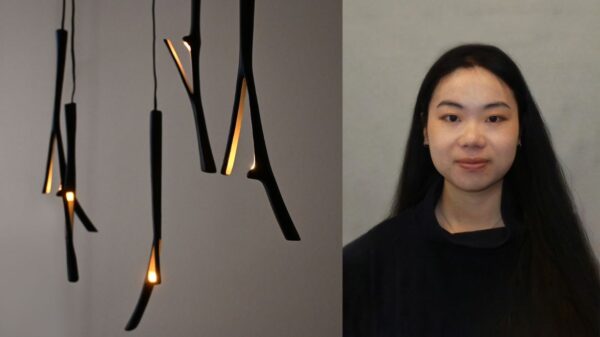
Winner of the Emerging Lighting Product Design of the Year 2025 at the LIT Lighting Design Awards, CinderGlow is a pendant light shaped by rupture, resilience, and the quiet power of light to heal. Designed by Yuxin Luo while studying at ArtCenter College of Design, the project emerged in response to the Eaton Fire that devastated parts of California, transforming loss into a tactile, luminous gesture of renewal.
Inspired by a broken branch found in Altadena, CinderGlow places light directly within a fracture, allowing warmth to radiate from damage rather than conceal it. The piece balances wood-like texture with organic movement, using modular construction and additive manufacturing to support local production, easy disassembly, and a low-impact lifecycle. Conceived as both a poetic object and a sustainable system, CinderGlow reflects a young designer’s intuitive approach to material, memory, and meaning.
In this interview, Yuxin Luo reflects on the experiences that shaped CinderGlow, the challenge of translating emotion into form, and how receiving the Emerging Lighting Product Design of the Year 2025 title has helped affirm her voice in contemporary lighting design.
CinderGlow // Yuxin Luo
1. Could you tell us a bit about your background and how you found your way into lighting and product design?
I studied Environmental Design for my undergraduate degree and pursued Graphic Design at the graduate level. My path to lighting was quite unexpected: my packaging design professor saw the forms I was developing and kept suggesting I try furniture and lighting design. I decided to give it a try since I had been interested in this area before, and that’s how I began.
2. CinderGlow is built around the idea of “growing from where it breaks”, can you tell us more about this vision?
The seed for this concept was planted earlier, at Notre-Dame in Paris. The contradiction between the weight of history and the freshness of a newly renovated space gave me a feeling of loss. But as I left, a corner of glowing candles drew people together. In that silent, shared light—warm, wordless and I felt connected. That was my first real-life understanding of light as a symbol of hope. After returning, I visited Altadena, a community deeply scarred by the Eaton Fire. I saw many hearths standing alone, with traces of different lives against a backdrop of charred trees; the scene felt profoundly grey and silent. Standing there, I have a strong feeling to re-light this place, to use light to bring warmth and hope back to the land.
3. You’ve mentioned finding a broken branch after the Eaton Fire. Can you walk us through that moment and how you were able to recreate that specific branch and light effect into the form and structure of the lamp?
I was struck by the resilience of the burnt branches—how a fragile exterior could hide a still-solid core. When I found one with a clean split, I intuitively inserted a battery-operated spotlight. It happened to wedge itself in stably, and light grew from the fracture. That moment was the start of the entire project. For the form, I must credit that original branch. I tried designing branch-like shapes from imagination, but they just didn’t feel right. Then I returned to that original branch, restoring its form precisely. The rest of the design language flowed naturally from there.
4. You describe CinderGlow as modular, allowing local production and easy disassembly. How is that modularity actually achieved in the design: what are the main components, and how do they come apart?
The modularity is achieved through a three-part system. The main body is the 3D-printed shade. Inside, a self-contained lighting module housing the Little Dot SMD LED Accent Lights and Paperwood for the interior split section. This assembly connects to the vertical hanging rod via a mechanical, glue-free joint— typically by inserting a metal sleeve internally for strength. This approach allows each light to be easily separated for repair, recycling, or local manufacturing.
5. Future versions are planned in recycled wood filament from fire-damaged trees. How do you imagine working with that material in practice, and what changes do you figure it will bring to your making and assembly process?
Working with recycled wood filament from fire-damaged trees would present a different texture—likely rougher, making it harder to achieve a perfectly smooth surface. The internal grain revealed after polishing would also be unpredictable. These are challenges, but also opportunities. I envision the making process involving less human intervention. For instance, I might reduce extensive polishing to preserve its inherent, less-refined texture. The interior of the split might not feel like conventional wood, but that’s the interesting part. It becomes a collaboration between the traces forged by nature and human expectations of aesthetics, which could give each piece a unique texture.
6. Could you walk us through your sustainability approach, from material choices to production?
Sustainability was a consideration from the start. I initially tried to handcraft pieces from branches collected in Altadena, but my skills then couldn’t realise the vision, so I compromised by using 3D printing for the prototype. In the design, I avoided irreversible adhesives. For example, the vertical parts are connected by inserting a metal tube inside, ensuring strength. As mentioned, using recycled wood filament is the ultimate goal for material choice. Furthermore, the modular design and the vision for local production aim to reduce transportation emissions and extend the product’s lifecycle.
7. What were the biggest challenges you faced while developing CinderGlow and how did you work through them?
The two main challenges were achieving the desired light quality and concealing the light source and wiring to maintain the natural resemblance. For light quality, the challenge was achieving a glow that was soft, bright, yet not harsh. I experimented with different types and scales of light sources, constantly adjusting the LEDs’ placement, depth and angle. I also added paperwood over the split section, which helped further soften and diffuse the light. Hiding the components posed a distinct challenge. The key was to identify and scale a natural element that could integrate them discreetly. This led to the “branch knot”—a form that naturally conceals the light source. For the wires, the solution spanned from tucking a single wire into the trunk of a branch to shaping the entire vertical hanger.
8. Congratulations on winning at the LIT Lighting Design Awards! What does this recognition mean to you personally, and how do you think it might shape your path as a young designer?
This was a complete surprise and a tremendous encouragement for my first lighting piece. As a newcomer to product design, I followed my instinct on what felt right but didn’t truly know the industry’s criteria. Therefore, the most precious aspect of this recognition is that it tells me that I am on the right path. It has solidified my direction and intuition and also makes me think further about the next steps: how to build on this and further develop it using different potential elements.
9. Looking ahead, what kinds of projects are you interested in exploring next, and what advice would you give to other design students who hope to develop award-winning, meaningful work of their own?
I’m drawn to exploring materials and craft on a larger scale, focusing on the dialogue between human-made forms and natural patterns, and to learning more and incorporating deeper thinking into materials, the translation from inspiration to form, and so on. As for advice, I would say to take the time to observe and dig into what you genuinely feel. Find your own interpretation and voice. Then, follow it to find the technical solution until it matches the vision in your mind. Throughout the process, embrace humility and mistakes.
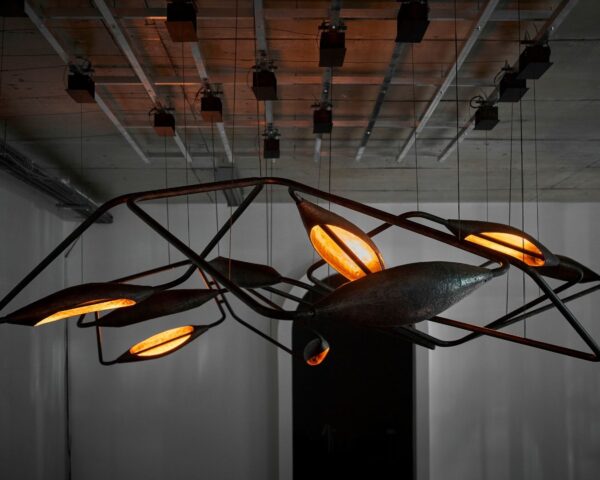
Winner of the LIT Lighting Design Awards in Lighting Product Design, Amphora is a sculptural chandelier that blurs the line between lighting and living form. Designed by Martin Döller for his studio One to One, the piece draws inspiration from ancient amphora vessels and the organic geometry of seed pods, reimagined in solid bronze with a deeply tactile, patinated finish.
Conceived as a modular system with articulated joints, Amphora allows each light pod to be oriented independently, shaping illumination with precision while maintaining a distinctly natural presence. Installed in a residential interior by ARRCC in Buenos Aires, the chandelier demonstrates One to One’s biophilic approach to lighting, where atmosphere, materiality, and human wellbeing are inseparable.
In this interview, Martin Döller reflects on the philosophy behind Amphora, the role of craftsmanship and longevity in contemporary lighting, and why light should always be experienced as more than a functional necessity.
Amphora. Photo Credits: Sean Gibson // Martin Döller
1. Could you tell us a bit about your background and the story of how you came to found One to One?
The genesis of ONE TO ONE came from a deeply personal experience. During solitary explorations in the African wilderness, I experienced firsthand the profound impact natural light had on my wellbeing—my mood, sleep patterns, energy levels, mental and physical health. We can all relate to how good we feel in nature during sunrise, sunset, even around campfires. That visceral connection to light became the foundation of everything we do.
This innate human affinity to nature’s impact on wellbeing is what scientists call “biophilia,” and it fuels our entire philosophy of experiential lighting. I initially tested this theory in residential homes—the centre of the human heart—using three types of lights: task, mood, and theatrical lighting to artificially recreate the experience of natural lighting and that profound sense of wellbeing. Over 20 years, we’ve grown from that initial insight to delivering over 1000 projects across four continents, but the core philosophy remains unchanged: light is an experience, not a product.
2. What was the original vision behind Amphora? What did you hope this piece would express or change in the way we experience light?
Amphora represents a convergence of ancient symbolism and contemporary lighting philosophy. The name derives from the Greco-Roman vessels that held wine during the Bronze Age—in our case, solid bronze Amphora vessels of light. The design was inspired by seed pod shapes found in nature, capturing that organic essence we’re always pursuing.
What I hoped to express was versatility without compromise. We wanted to create a piece that could be infinitely customised while maintaining sculptural integrity— something that transcends mere illumination to become light art. The goal was to challenge the conventional chandelier form and instead offer something that could adapt to any space, any vision, while always maintaining that connection to natural forms. It’s about bringing nature’s language into built environments.
3. Amphora has a very organic, seed-pod form. How did this shape develop, and what did you want it to bring to an interior space?
The seed pod form emerged from our ongoing study of biophilic design—how nature creates vessels that are both protective and generative. Seeds represent potential, growth, life itself. That organic, oval body with its distinctive profile creates a warmth and approachability that geometric forms simply can’t achieve.
What’s crucial is how this shape interacts with light. The pod form allows light to emanate from within, creating that warm glow reminiscent of natural phenomena— think of sunlight filtering through leaves, or the way firelight dances. We wanted each pod to feel alive in a space, not just decorative but experiential. The organic form 1also means it never competes with architecture; instead, it complements and enhances spatial character in a way that feels innate rather than imposed.
Amphora. Photo Credits: Sean Gibson
4. Amphora was designed as a modular system with articulated joints, which allows each pod to be positioned differently and direct light in multiple ways. Can you tell us a bit about this construction decision?
The modularity was essential for several reasons. First, every space we work with has unique architectural language, proportions, and lighting requirements. By creating a system where each pod can reticulate along all its joints, we’ve made the configurations essentially endless. The light source direction within each pod is also adjustable, allowing it to shine in almost any direction.
This flexibility serves our broader philosophy: lighting must respond to the space, not dictate to it. In practice, this means an Amphora installation in a Cape Town residence might be configured completely differently from one in Argentina, yet both feel perfectly integrated into their respective environments. The articulated joints allow us to create dynamic compositions that can emphasise vertical drama, horizontal spread, or clustered intimacy—whatever the space demands. It’s architecture for light.
5. You chose solid bronze as the main material, and your signature patinated finish means no two pieces are the same. What attracted you to bronze, and how do you develop the patina on each Amphora?
Bronze was a deliberate choice rooted in permanence and authenticity. It’s a material with ancient provenance—connecting directly to those original Greek amphora vessels—but it also possesses qualities essential for fine lighting: structural integrity, thermal properties that handle heat beautifully, and that extraordinary surface that develops character over time.
The patination process is where each Amphora truly becomes unique. Patina naturally forms on bronze and copper surfaces through atmospheric exposure, but we apply this in an accelerated, controlled manner. The process serves both aesthetic and preservation purposes, adding depth and character that contribute to each piece’s individuality. The colours can range from subtle browns and greens to vibrant blues and reds, with detailed patterns that evolve through the surface’s texture and the skill of our patina artist.
What’s beautiful about this approach is that it honours both craftsmanship and natural processes—every Amphora carries the mark of the artisan’s hand, making each installation truly one of a kind. No two patinas are identical; they respond to how the chemicals interact with the bronze, the humidity, the time of day the work was done. It’s lighting that carries its own story.
6. You’ve spoken about your commitment to local craftsmanship. Can you tell us how these artisans are involved in the production of Amphora?
Our commitment to local craftsmanship is fundamental to who we are. The patination process I mentioned requires exceptional skill—these are artisans who understand 2metal intimately, who can coax colors and patterns from bronze that feel both controlled and organic. Each patina artist brings their own sensibility to the work, which is why every Amphora has such distinctive character.
Beyond the patina artists, we work with metal fabricators, casters, and finishing specialists—all bringing generations of knowledge to contemporary applications. This isn’t just about supporting local economy, though that matters deeply to us. It’s about maintaining standards of quality that only come from human expertise and care. These artisans are collaborators in the truest sense, bringing their understanding of materials and processes that inform how we design.
In a world of mass production, this approach may seem inefficient, but it’s essential for the calibre of work we’re committed to. Our clients aren’t purchasing products; they’re investing in pieces that carry the touch of skilled hands and will remain timeless for generations.
7. What were the main challenges you faced while developing Amphora and how did you and your team overcome them?
The primary challenge was achieving that perfect balance between modularity and sculptural coherence. We needed joints that were robust enough to support the bronze pods at various angles, yet elegant enough not to interrupt the organic flow of the design. This required extensive prototyping—testing different joint mechanisms, load distributions, and electrical routing solutions.
The patination process also presented interesting challenges. Achieving consistency in the accelerated ageing process while celebrating individuality required developing strict protocols that still allowed for artistic interpretation. We had to ensure that every Amphora, regardless of when or by whom it was patinated, would meet our quality standards while maintaining that unique character.
Electrically, creating a system in which light sources could be positioned directionally within each pod while maintaining clean cable management through the articulated joints required innovative engineering. We worked through multiple iterations with our technical team, often going back to the drawing board when a solution compromised either functionality or aesthetics.
Ultimately, we overcame these challenges through iteration, collaboration between our designers and fabricators, and refusing to compromise on either artistic vision or technical excellence. Some solutions took months to refine, but that persistence is evident in the final piece.
8. Congratulations on winning the Chandeliers category at the LIT Lighting Design Awards! What does this recognition mean to you personally and to the One to One studio?
This recognition is profoundly meaningful on multiple levels. Personally, it validates a design philosophy I’ve been developing for over two decades—that lighting can and should serve human wellbeing, not just functional or aesthetic purposes. To have 3Amphora recognised on the global stage affirms that this biophilic approach resonates beyond our local context.
For the ONE TO ONE studio, this award represents a milestone in our journey from Cape Town to international recognition. We’re a South African studio competing on the world stage, and winning demonstrates that exceptional design isn’t geographically limited. It’s particularly meaningful given that we’ve always prioritised substance over flash—our work is about atmosphere, wellbeing, and connection to nature, not trends.
This recognition also honours our entire team: the designers, fabricators, patina artists, and everyone who contributes to our work. It validates our commitment to craftsmanship, to local production, to quality over quantity. And it positions us to have broader conversations about how lighting affects human health and happiness— conversations I believe the design industry needs to be having more seriously.
Amphora. Photo Credits: Sean Gibson
9. Looking ahead, what kinds of projects or directions are you excited to explore, and what advice would you give to aspiring lighting designers?
I’m particularly excited about the growing awareness of circadian rhythm lighting and its impact on human health. We’re moving beyond the idea that lighting is simply about visibility or aesthetics—it’s about wellness, about reconnecting people with the natural rhythms that modern life has disrupted. I see enormous potential in the hospitality and residential sectors for lighting that actively improves guests’ and residents’ well-being.
I’m also eager to explore larger-scale installations that push the boundaries of what experiential lighting can achieve. Following pieces like Stemma—the largest residential chandelier in the world—I want to continue creating installations that blur the line between lighting and sculpture, that become defining architectural elements.
For aspiring lighting designers, my advice is threefold: First, study natural light obsessively. Understand how it behaves throughout the day, across seasons, and in different geographies. Nature remains the ultimate teacher. Second, don’t be scared of the dark. Restraint in lighting often creates a more powerful atmosphere than overillumination. Learn when to withhold light, not just where to add it. Third, remember that you’re designing experiences, not products. Every lighting decision affects how people feel in a space—their mood, energy, even their sleep later that night. That’s a profound responsibility. Embrace it, and let it guide you toward work that genuinely serves human wellbeing alongside aesthetic ambition.
In this interview, we speak with the interdisciplinary student team behind Flight into Shadow, an award-winning architectural lighting installation created for the Venice Architecture Biennale. Recognised in the Emerging category of Architectural Lighting Design at the LIT Lighting Design Awards, the project explores how light, shadow and material intelligence can help us adapt to heat-stressed urban environments, not through technology alone, but through spatial experience.
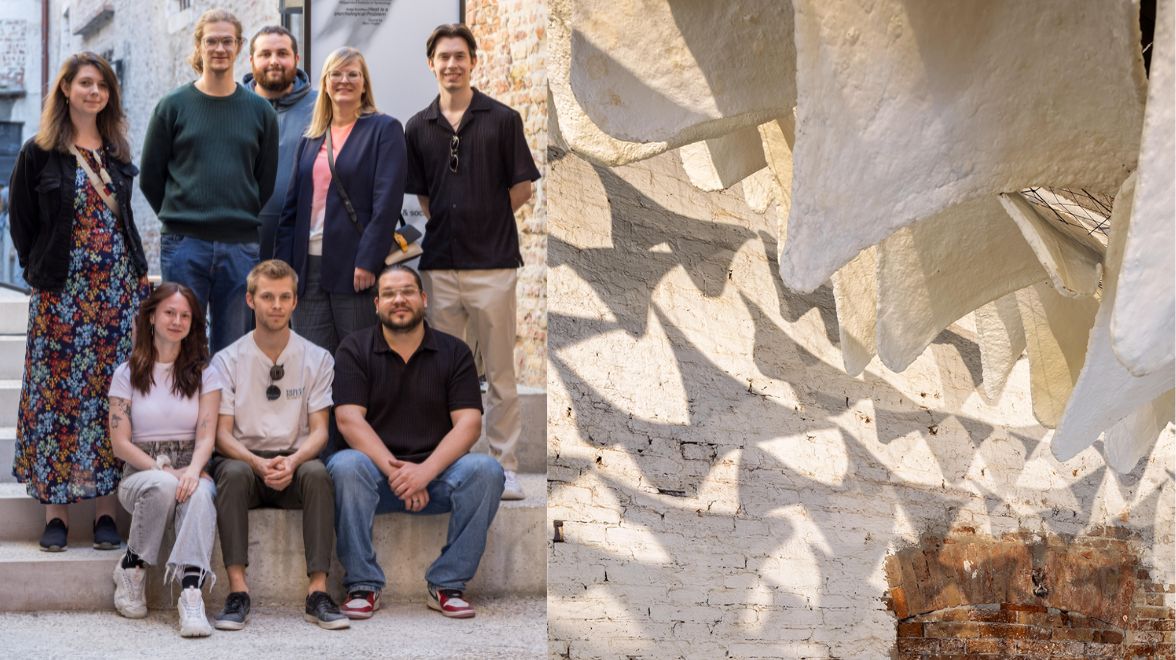
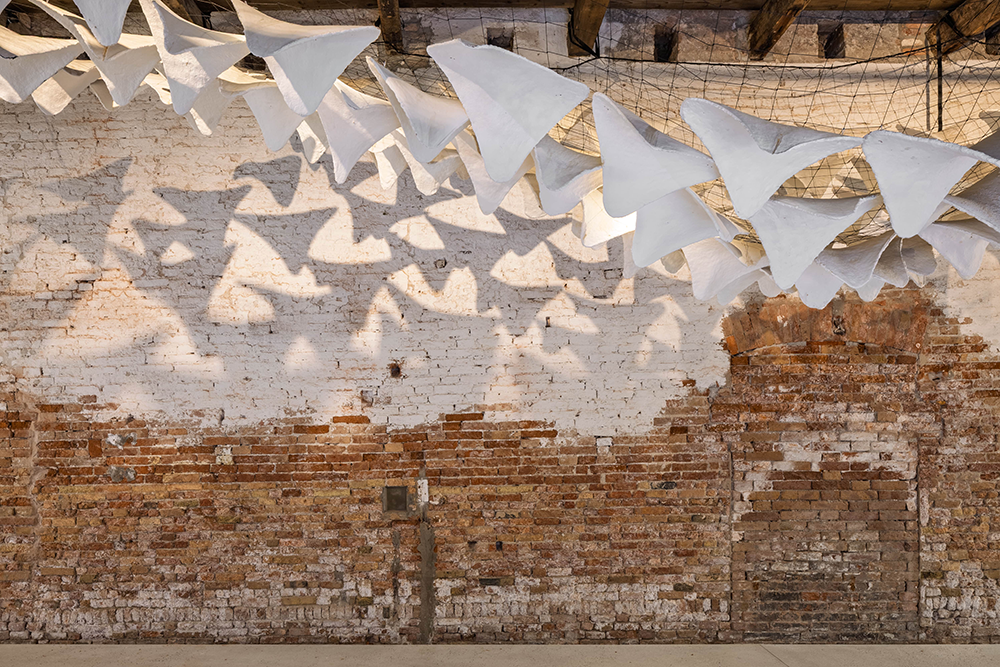
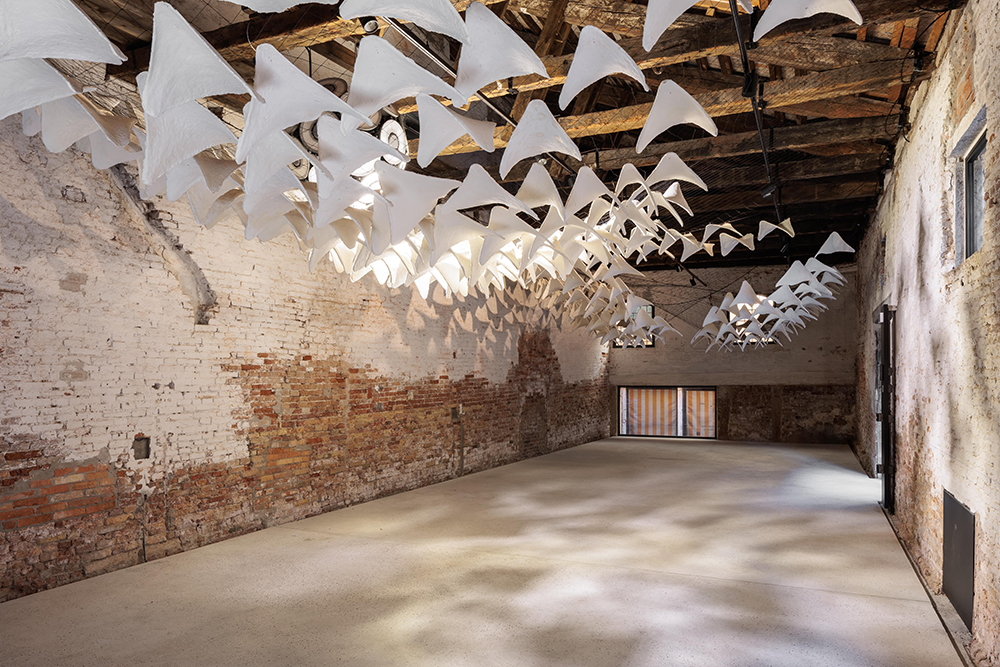
Developed by students Burak Bardakci, Miriam Haidn, Nico Karl, Jannick Lippert, Franziska Rieder, Sara Salamun, Jesse Voigt and Malik Yalniz, from the Deggendorf Institute of Technology (DIT), HFT Stuttgart and the University of Stuttgart, under the guidance of Prof. Sabine Wiesend and collaborating professors, Flight into Shadow was realised at Salone Verde Art & Social Club in Venice as part of the Keep Cool! Workshop for Cool Cities. At its centre is a bold architectural gesture, an artificial sun composed of individually controlled luminaires, paired with delicate mycelium structures that act as living filters, allowing shadow to emerge, soften and evolve.
Inspired by the Komorebi effect, the fleeting dance of sunlight through leaves, the installation transforms a natural phenomenon into a carefully choreographed environment. Visitors move between moments of glare and relief, exposure and refuge, experiencing light as a dynamic and emotional force. In the interview that follows, the team reflects on how the project came together across disciplines and institutions, the challenges of creating a controlled indoor sun, and why shadow may be one of the most powerful tools for designing comfort in a warming world.
Flight into Shadow team // Flight into Shadow. Photo Credits: Jacopo La Forgia.
You came together as a group of students from different backgrounds and universities. How did you first meet, and what made you decide to work together on Flight into Shadow?
Flight into Shadow began with the idea of collaboration itself and the belief that complex challenges can be addressed more effectively when people from different backgrounds work together. With this mindset, Professors Diane Ziegler, Ralf Petersen, Martin Ostermann and Sabine Wiesend initiated the project, connecting multiple disciplines and institutions from the outset. The project was closely linked to a real spatial context. Salone Verde, with its owners Anna and Ralf Petersen, offered not only a venue but an active collaborative environment in which Flight into Shadow could be developed as part of the Keep Cool! Workshop for Cool Cities was realised as a full-scale installation.
Through the specialised elective course Architecture Biennale 2025, Prof. Sabine Wiesend, Professor for Lighting Technology and Lighting Design, offered master students of Media Technology at the Deggendorf Institute of Technology (DIT) the opportunity to join the Flight into Shadow team. This once-in-a-lifetime opportunity allowed us to actively contribute to a visionary project, ultimately exhibited in Venice during the world’s largest architecture exhibition, where light and mycelium merge into a stunning symbiosis, raising awareness for innovative approaches to urban overheating.
At the same time, the participating professors assembled student teams from their respective universities, officially launching the project. This combination of different universities, disciplines, and areas of expertise formed the foundation of Flight into Shadow and allowed it to develop into a truly interdisciplinary collaboration.
Our first meeting took place online at the beginning of February 2025, followed by a mycelium workshop at FUMA Lab and from there the project continued to evolve.
What is the story behind this project? What vision or moment of inspiration led you to explore heat, light, and shadow in this way
Flight into Shadow grew out of the question of how we can live with heat and how we can adapt to it. This topic is central to the Architecture Biennale 2025 and also lightly aligns with themes explored in the German Pavilion. From the beginning, we wanted to approach this challenge with a positive perspective, focusing not on fear or limitation, but on creative and actionable solutions.
Rather than relying on energy-intensive technologies to create comfort, Flight into Shadow draws inspiration from cultures that have long lived with high temperatures and developed intelligent, passive strategies of adaptation. In this context, shadow is not treated as a secondary by-product, but as an essential design tool capable of shaping comfort, perception, and atmosphere.
The project connects directly to the Biennale’s overarching theme Intelligens. Natural. Artificial. Collective. By working with intense artificial light, living materials, and collaborative design processes, the installation explores how different forms of intelligence can shape our perception of heat, comfort, and space.
At Salone Verde, these principles are translated into an artistic spatial experience. Mycelium plays a central role not only as a natural, compostable material, but as a mediator between nature and the built environment. The mycelium panels form a sculptural canopy of shade beneath an intense artificial sun, creating spaces of relief.
The vision behind the project was to make heat physically and emotionally perceptible and to show, through direct experience, how light and shadow shape our sense of comfort. By placing visitors between exposure and refuge, Flight into Shadow invites a more conscious awareness of how we might adapt to heat in everyday spaces.
The project “invites the Sun indoors” and creates a controlled solar experience, independent of the real weather outside. In practical terms, how did you achieve that?
To create a controlled “indoor sun” independent of outdoor weather conditions, we focused on luminous intensity, spatial form, dynamics and the deliberate creation of shadows.
For the sunball, we used 26 luminaires, each delivering approximately 20.000 lumens. Combined, their output allowed us to achieve an extremely high level of illumination – naturally still far below that of the real sun, but sufficient to create an intense and convincing solar presence within the space. The light is deliberately directed, allowing it to spread into the room and interact with surfaces and the mycelium cloud to generate dynamic shadow patterns. At the same time, it is not as narrowly focused as the real sun, enabling the light to shape the atmosphere rather than forming a single, sharply defined beam.
Equally important was the physical form of the “indoor sun”. A significant part of the process involved developing a structure that could combine all 26 luminaires into a spherical configuration that visually and spatially evokes the sun. Each luminaire was assigned a precise position to ensure optimal light distribution and to orchestrate the formation of layered shadows. The supporting structure, along with the entire lighting control system and cabling, was custom-designed and manufactured by us at our university, enabling the creation of dynamic scenes and a continuously evolving interplay of light and shadow throughout the installation.
You describe a “choreography of light” that shifts between harsh exposure and gentle refuge. How did you design and programme this sequence of moods and scenes?
The choreography of light was developed through a combination of simulation-based planning and on-site adaptation. We began with virtual lighting simulations to define where visitors should be deliberately exposed to intense brightness and where zones of shadow would provide visual relief. For each scene, we evaluated different parameters such as contrast and intensity to ensure a carefully balanced spatial experience.
Next, we designed a sequence of distinct lighting scenes and simulated each individually to verify that exposure levels were maintained throughout the transitions. Since the final geometry of the mycelium cloud could not be fully predicted until installation in Venice, a significant part of the design process took place on site. This required extensive fine-tuning to respond to the actual spatial conditions and to make the experience truly site-specific.
During on-site programming, we ensured that the interaction between space, light, and shadow was constantly evolving, allowing visitors to continuously discover new shadow situations. Particular attention was paid to the timing and interaction of individual luminaires, carefully considering when each light dims or intensifies and how these changes influence the perception and atmosphere.
The entire lighting choreography was programmed using Bluetooth-controlled systems. In addition to the luminaires, a hazer was integrated to create atmospheric light beams, allowing the light to become visible in space and emphasising the contrast between intense exposure and shadow through pronounced god rays.
Flight into Shadow. Photo Credits: Jacopo La Forgia.
The installation brings together a powerful artificial sun and delicate mycelium structures. Why did you choose mycelium and these particular lighting elements, and how does each one help you express your vision?
The choice of the artificial sun and the mycelium was guided by the Biennale’s overarching theme Intelligens. Natural. Artificial. Collective.
The artificial sun represents artificial intelligence in a broader sense: a human-made system that generates intense light and heat through technical means. It stands for control, optimisation, and technological intervention, and introduces an intentionally industrial contrast through its scale and appearance. Digital simulation and control play a key role in its configuration and operation, confronting visitors with an exaggerated condition that reflects how we often respond to environmental challenges through engineered and highly controlled solutions.
The mycelium represents natural intelligence. As a living, fast-growing material, it adapts to its environment and forms networks rather than isolated elements. Suspended as a canopy, it creates shade and relief through its inherent material behaviour, without relying on active or energy-intensive systems.
The collective intelligence of the project lies in the collaboration itself. Flight into Shadow was developed through the cooperation of HFT Stuttgart Interior Architecture, Deggendorf Institute of Technology (DIT), and the University of Stuttgart IBK2. Each institution contributed distinct expertise, and the project could only emerge through this shared process.
Together, these elements help express our central vision. The artificial sun makes heat and exposure tangible, pushing visitors into an uncomfortable, heightened state of awareness. The mycelium responds to this condition by offering shadow, calm, and spatial relief, demonstrating how natural systems can counterbalance extreme environments. The collaboration between the three universities reflects the idea that responding to complex challenges like climate and urban heat requires shared knowledge and collective effort. In this way, the installation translates different forms of intelligence into a direct, physical experience.
When a visitor steps into the installation for the first time, what do you hope they feel, notice, and take away from the experience?
When visitors step into the installation, we want the first reaction to be physical rather than intellectual. The light is deliberately intense and uncomfortable, similar to the feeling of looking into the sun. That moment of glare is meant to trigger an immediate sense of heat and strain, reflecting how increasingly extreme sunlight already affects our everyday lives and how this will only intensify with climate change.
As people move through the space, they quickly discover the opposite experience: stepping into the shadow brings instant relief. The glare softens, the heat feels less oppressive, and the body can relax. This contrast is intentional; it shows how even small, thoughtful interventions can make harsh conditions more bearable.
One of the key ideas we want visitors to take away is that comfort does not require massive technological solutions, even with a powerful “sun” dominating the room.
The installation is not meant to be purely didactic. It is an artistic experience, and we want people to enjoy the aesthetics, the mood, and the emotional quality of the space, leaving with a feeling that is as memorable as it is reflective.
Your sustainability approach works on several levels, from compostable mycelium to reused luminaires and energy-efficient control. Can you walk us through the key decisions you made to keep the project as low-impact as possible?
Our sustainability strategy was built around a series of conscious, practical decisions rather than a single overarching gesture.
First, we deliberately selected mycelium as a key material. Mycelium is fast-growing, requires very few resources to produce, and is fully compostable at the end of its lifecycle, making it an ideal counterbalance to the more technical elements of the installation, both environmentally and conceptually. At the same time, mycelium is still an experimental material under active research and does not yet have an established market application. Within this project, it was explored in a three-dimensional, spatial form, contributing to ongoing research and helping to further develop its potential as a building material.
Second, we chose to work with already existing luminaires, which were kindly donated, instead of purchasing new ones. By reusing these fixtures, we were able to extend their lifecycle, avoid new production, and significantly reduce material waste and associated manufacturing emissions.
Third, the entire supporting structure was designed and fabricated locally in Deggendorf by the team itself. Producing the construction on site allowed us to minimise transportation distances, reduce emissions and costs, and maintain full control over material use and assembly.
In addition to these material choices, we paid close attention to energy use through efficient LED technology and intelligent control systems, ensuring that light output, scenes, and operating times were precisely managed and never excessive.
Together, these decisions allowed us to keep the project’s overall environmental impact as low as possible while still achieving a strong spatial and emotional effect.
What were the biggest challenges you faced, and how did you solve them as a team?
The biggest challenge we faced was the extremely limited timeframe. The project was initiated at the end of December, and we had only about four months to develop, build, and realise a highly complex installation. For a project of this scale, this was far from ideal.
This challenge could only be overcome through strong teamwork, a shared commitment, and the dedicated support of our professor. Everyone was willing to take responsibility, adapt quickly, and push through moments of uncertainty and pressure. The guidance and encouragement from our professor, combined with the dedication of the entire team and even small contributions from external supporters, made it possible to meet the demanding schedule. There were phases where the workload and pace were genuinely intense, but the collective determination to create something meaningful and unique kept the project moving forward.
In the end, the result speaks for itself. Despite the tight schedule, the team managed to deliver a successful installation, which reinforced the value of collaboration, trust, persistence and shared dedication under real-world constraints.
Flight into Shadow has now received a LIT Lighting Design Award. Congratulations! What does this recognition mean to you, and how does it resonate with the message of the project?
Receiving the LIT Lighting Design Award means a great deal to all of us. It is a strong recognition of the hard work, commitment, and collaboration that went into the project. Beyond that, it confirms that the themes we are addressing resonate with a wider audience and that the project is able to communicate its message effectively through light and space.
In the context of Flight into Shadow, the award feels especially meaningful because the project is not only about highlighting challenges such as climate change and extreme conditions, but also about offering a sense of agency and optimism. The recognition reinforces our belief that design can open up more hopeful perspectives on the future and contribute to meaningful conversations about how we want to shape it.
Flight into Shadow. Photo Credits: Jacopo La Forgia.
How do you see this experience influencing your future work, and what advice would you give to other students who hope to develop and exhibit projects at this level?
Like any major challenge, this experience taught us a great deal. We learned how to deal with unexpected problems, how to manage time under real pressure, and how to make decisions when conditions are far from ideal. One of the most important lessons was realising how much can be achieved when everyone contributes their strengths. Trust and reliability within the whole team proved essential; without them, even small challenges can quickly escalate into serious problems. Teamwork was crucial, and we also learned that a small amount of luck often plays a role in bringing complex projects together.
Looking ahead, this experience will strongly influence our future work. It has given us confidence to take on ambitious projects and to trust collaborative processes, even when timelines are tight and outcomes are uncertain.
Our advice to other students is simple: opportunities like this are rare, and when they come, you should take them, even if the timeframe is short and the challenge feels overwhelming. Projects at this scale are demanding, but they are also incredibly rewarding. Surround yourself with a committed and reliable team, trust the process, and be willing to learn along the way.
We would like to express our sincere thanks to the whole Team who made this project possible:
Lighting Design & Light Engineering Deggendorf Institute of Technology (DIT) Prof. Sabine Wiesend, Franziska Rieder, in collaboration with the Department Mechanical Engineering Prof. Stefan Scherbarth
Mycelium Research, Production & Design HFT Stuttgart, Interior Architecture Prof. Diane Ziegler, Melissa Acker, Jürgen Aldinger, Romano Bianchi, Christoph Bihlmaier, Holger Bitterberg, Elisabeth Bokesch, Willi Mauch, and the students of HFT Stuttgart
University of Stuttgart, Institute of Building Construction, Building Technology and Design (IBK2) Prof. Martin Ostermann, Eliza Biala, Mostafa Aboughaly, Piotr Baszynski, Andreas Schedler, Petr-Jiri Sebera, Simon Vogt, and the students of the University of Stuttgart
Salone Verde Art & Social Club Anna Petersen and Prof. Ralf Petersen, curator Era Merkuri, Isotta Predieri with Predieri+Varini Architetti Associati
Their support, expertise, and trust gave us the opportunity to realise this project and quite literally let the shadows grow.
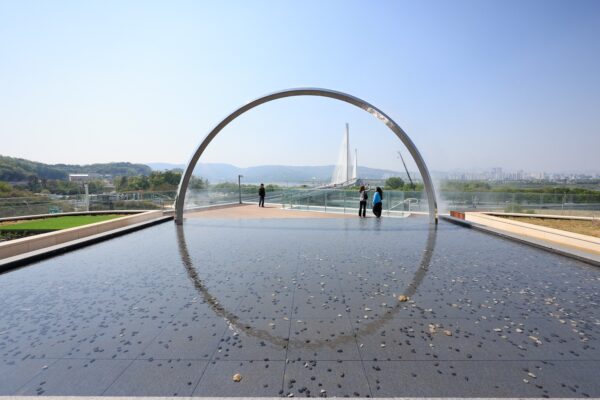
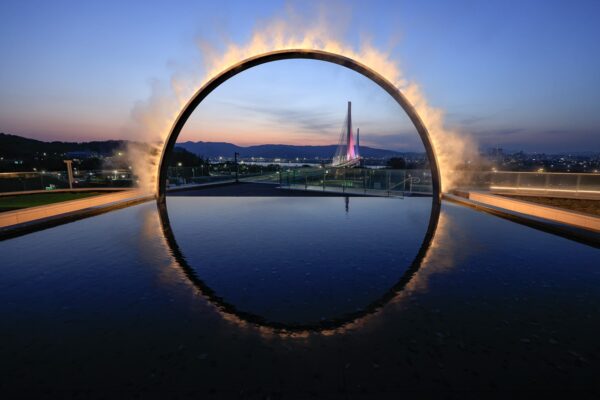
Lighting installation Arc ZERO: Eclipse is not an object so much as an encounter. Rising from a reflecting pool on a rooftop overlooking the Han River in Seoul, the installation uses light, mist, and atmosphere to momentarily dissolve the familiar rules of space, scale, and perception. Created by Australian artist James Tapscott of Studio JT, the work transforms elemental materials into a circular apparition that feels at once precise and elusive, engineered yet deeply poetic.
Winner of the Entertainment Lighting Design of the Year title at the LIT Lighting Design Awards, Arc ZERO: Eclipse, builds on Tapscott’s long-standing exploration of light as a spatial and sensory medium. Neither purely architectural nor purely sculptural, the piece exists in dialogue with its site, the skyline, and the shifting conditions of wind, humidity, and time. In this interview, Tapscott reflects on his journey from painting to large-scale light works, the evolution of the Arc ZERO series, and how restraint, sustainability, and a deep respect for natural phenomena continue to shape his practice.
James Tapscott // Arc ZERO: Eclipse.
Could you tell us a little about your background and how Studio JT came to be?
I originally studied painting at art school and figured that would be my career until travelling to the US some years afterwards – I was amazed at the works I saw in California; Richard Serra, James Turrell, Olafur Eliasson, Robert Irwin, etc. My education was pretty limited prior to the internet due to Perth’s geographical isolation and so these works were a real eye-opener as to what else art could be. So I transitioned, slowly (it’s hard to turn your back on 10+ years of practicing a medium) and grew my style of working in the more remote areas of Australia, playing with light and the landscape. Eventually, this led to commissions for large-scale works, both temporary and permanent, and Studio JT was formed to embrace this growth.
What was the original vision behind the Arc ZERO series, and how did that idea evolve into Arc ZERO: Eclipse?
The first Arc ZERO was commissioned by Art Front Gallery in Japan for the inaugural Japan Alps Festival. It was really a direct response to the site and curatorial theme of water. The site was a small forest at the entrance to an important temple called Hotokizaki Kanon-Ji with a strangely angled bridge over a rushing stream. This exact site just felt important in a way, and also served as a crossing, not just of the river, but from one place to the next. The work’s intention was to frame this crossing and mark the moment one moves through to a more spiritual realm. The nature of the site was so beautiful, I wanted to be equally as elemental in my choice of materials and form, so a circle of mist and light was the best response.
The next iteration of the work was in a vastly different environment – a new shopping mall in Shenzhen. It still had a few shop spaces unleased and so the curator, Keith Lam, produced a fantastic exhibition of works by artists around the world to use these spaces. It was a more controlled space, and much more minimal, so I sought to create a work that was more visually profound. Using the water pooling from the condensed mist to create the full circle with its reflection did something amazing to one’s perception of the space – as if there was no floor, no horizon, even no gravity since all other visual reference points were eliminated in the dark space. The artwork cast a shadow within itself, too – in space (rather than on a surface where we normally encounter shadows). It was a hugely successful piece, attracting over 400,000 people who lined up to see it over the course of a month.
Why did you choose this precise combination of a rising arc and reflecting pool, creating a complete circle in perspective, and what kind of visual experience were you aiming for for viewers looking over it from the roof?
I think it creates an experience of greater immersion in the site itself, not just the work. The normal visual rules we use to assess and navigate space don’t really apply, so one tends to become more observant and open to the raw visual information they’re receiving. The work itself needs the site to be complete, which brings together a sense of harmony and interconnectedness. My work is all about producing a moment of pure co-existence with nature, so it functions on many levels in this way. The circle is such a pure form, it doesn’t bring any intellectual baggage that can cloud this experience, and also fits perfectly with the overall curation of the development’s art collection, based around the Cheonbu concept.
Arc ZERO: Eclipse, James Tapscott
Light, mist and atmosphere are the real “materials” of this piece. How did you approach the lighting design so that the mist, the ring, and the surrounding skyline all interact in the way you imagined?
The strategy (as it is with much of my work) is to allow all the elements to speak for themselves. The unique texture and organic movement of the mist are so special that they just need basic illumination. And because the mist is what gives form to the light, this symbiotic relationship is crucial to the success of the work and what makes it unique. I think this approach also allows the work to really shine in any environment, as most urban lighting has a completely different aesthetic quality. The presence of something purely natural becomes much stronger, but doesn’t dominate or detract from the intention of the surroundings’ design strategy.
When the mist ignites with light, it can look like fire, shadow, or even an eclipse. What kind of emotional response from visitors were you hoping to create through this play of light and vapour?
I’m hoping people can achieve a true sense of wonder with my work – something sublime, which is what I think facilitates a moment of pure coexistence. They can stop processing everything they experience cerebrally, with language (which can be very limiting) and just feel their moment with the site. It’s also one of the reasons I work with mist in this instance, as it engages all the senses. It’s not just a visual, or even audio-visual experience, but a bodily one, with smell, touch and even taste contributing.
You have mentioned that the ring has a diamond profile. For readers who haven’t seen it in person, can you explain what this profile does visually, and why minimising self-reflection was so important to you?
It prevents any chance of a reflection of oneself from most of the viewing angles. I find that seeing myself in the surface of an object completely overrides whatever else I’m experiencing, and really breaks the moment. So I want people to be able to lose themselves in the work. It certainly makes it a lot more complicated and expensive to fabricate, however, so this approach is reserved for the permanent editions.
Arc ZERO: Eclipse builds on your earlier Nimbus works. In your view, what are the key differences between this installation and Nimbus, and what do those changes say about how your practice has evolved?
While still being visually striking, Nimbus becomes much more of a bodily experience as it is more immersive; one walks through the ring as they cross over the bridge it encircles, directly engaging their bodies and even the act of crossing within the artwork’s experience envelope. The work is also directly integrated with the site’s architecture, so it’s a very different approach. I find the Eclipse more of a standalone work, rather than site-dependent, though the site certainly shapes the experience in many ways. I’ve always explored different ways of expressing an idea, even the same idea through different site experiences, so these two works are part of an ever-evolving dialogue within my practice. I’m currently working on an installation next year in the US where both versions will be installed within the same site, so the dialogue will become quite direct. It’s exciting to see what will happen in this instance.
Sustainability was a key consideration in Arc ZERO: Eclipse. What specific design decisions did you make to reduce water consumption and ensure the lighting system is energy-efficient?
Water consumption is always a big issue – and for me personally, as I grew up in Perth and lived with water restrictions for many years. Currently, I live on only rainwater, which is a real management challenge, so I’m always conscious of its preciousness. The system is always tuned specifically to the site for each install, so it can vary, but over the years, it’s become more and more efficient. I remember during the development of the first edition, I spoke with spray nozzle system engineers and got drawn down an unexpected rabbit-hole of how much control you can exert on mist.
As for the lighting, most lighting nowadays can be produced quite efficiently, at least compared to 10-20 years ago. When I started working with light, LED wasn’t even an option and remote rigs were so cumbersome. And since this artwork is as much a daytime piece as it is a nighttime one, it delivers so much at minimal power consumption for the lighting.
Were there any particular challenges you faced on this rooftop site in Seoul, and how did you and your team work through them?
The installation logistics were managed by the project curation and management team at THE TON, who did a fantastic job throughout the entire project – I’ll let them answer this one directly.
The biggest challenge in this project was installing a permanent artwork, not on natural ground, but on a rooftop garden in an exposed environment right next to the Han River. We had to consider seasonal temperature changes, the risk of freezing in winter, strong winds, structural loads, waterproofing, and the pump and piping system all at once, so from the early design stage, we kept multiple scenarios open and refined the scheme through mock-ups and repeated on-site testing.
In that process, I coordinated among many stakeholders — the client JK MIRAE and the construction, landscape, and design teams — to align technical requirements and schedules, and thanks to the close cooperation of the client, who had a deep affection for the work, and the on-site teams, we were ultimately able to complete the installation safely and in a form suitable for a permanent piece.
At the same time, it was essential for us that the project did not stop at technical completeness, but that the work embodied James’s artistic intent and the curatorial direction we had set, so that it would operate in the most natural and beautiful way within the rooftop garden and Han River landscape — and that was the aspect our team focused on throughout the project.
– Jeehyeong Lee, Project Manager at THE TON
Arc ZERO: Eclipse, James Tapscott
Congratulations on winning the LIT Lighting Design Award! What does this recognition mean to you and to Studio JT?
Global industry and peer recognition are huge things – LIT Lighting Design Awards are proudly displayed by so many designers I know (I see them in their showrooms), so to win one of the major ones feels like a great success. I’ll display it with pride!
Looking ahead, what kinds of projects or experiments are you most excited to pursue next, and do you have any advice for young lighting designers?
I’m always looking for new ways for light and water to interact and have a few ideas to try out – and hopefully find the time to experiment directly with natural sites (this is how my practice grew many years ago). It’s easy to get swept up in big projects and forget where the roots of your creativity come from and they need regular nourishing. Which I guess is good advice for young designers too. I’d also say to be patient and take the time to find your voice, something unique that comes from within. Then you have something valuable to bring to the world, and something you’ll fight for. And be conscious of your relationship with technology. It’s a tool for us to use, not the other way around. I see so much work out there, especially with light, where the relationship is not so much that an artist is using technology to express an idea, but technology using an artist to show itself off. It’s a distinct difference, and one that will only become more important in years to come…
From poetic acts of remembrance in Brazil to ethereal light installations in Seoul and visionary student projects in Venice, the LIT Lighting Design Awards 2025 once again celebrated the extraordinary creativity and conscience of the global lighting community. With over 1,000 entries from 62 countries, this year’s winners prove that light remains one of the most powerful tools to shape how we see, feel, and connect with the world.
The Architectural Lighting Design of the Year, Memorial Brumadinho by Atiaîa Lighting Design, is a deeply human project that transforms tragedy into collective memory. Designed by Mariana Novaes and her team in collaboration with Gustavo Penna Arquiteto e Associados, the memorial honours the 272 victims of the 2019 dam collapse in Minas Gerais, Brazil. Through a choreography of darkness and illumination, visitors are guided through groves, reflecting pools, and quiet spaces that evoke empathy and remembrance. Every beam of light tells a story of loss, resilience, and resistance against oblivion.
In Seoul, Studio JT’sArc ZERO: Eclipse was named Entertainment Lighting Design of the Year, redefining how we perceive light, atmosphere, and reflection. The eight-meter stainless-steel ring floats above a still pool, its form completed by mist and light that respond to the changing air. Conceived by artist James Tapscott, the installation hovers between sculpture and phenomenon, a moment of quiet coexistence between technology and nature visible even from the city’s skyline.
The Lighting Product Design of the Year, Amphora by One to One by Martin Döller, pays tribute to the ancient vessels that once carried oil and wine. Cast in solid bronze and finished with a distinctive patina, each modular chandelier is both timeless and adaptable. With its sculptural seed-pod silhouette and adjustable light direction, Amphora embodies the perfect union of craftsmanship, sustainability, and emotion, a piece that feels as if it has grown naturally within its architectural setting.
Emerging lighting designers also shone bright this year. Flight into Shadow, created by students from the Deggendorf Institute of Technology, explores how light shapes perception, comfort, and relief in overheated urban environments. Presented during the Venice Architecture Biennale 2025 as part of the Keep Cool! initiative, the project transforms the ephemeral dance of sunlight through leaves into an architectural experience, a living meditation on adaptation in a warming world.
Meanwhile, Yuxin Luo, from the ArtCenter College of Design, earned Emerging Lighting Product Designer of the Year with CinderGlow, a pendant inspired by the California wildfires. Crafted from recycled wood filament, the piece transforms burned material into a source of warmth and beauty, a poetic metaphor for regeneration and hope.
This year’s Spotlight Prize was awarded to GreenLamp, a Swiss non-profit empowering women and midwives across rural Ethiopia through its three-pillar approach: LEARN | LIGHT | LEAD. Since 2012, GreenLamp has improved maternal healthcare for over 1.6 million women by providing solar-powered lighting and solar equipment for safe childbirth. The 2025 award supports their upcoming expansion by providing lighting infrastructure and equipement to two additional rural clinics. Each new solar lighting package includes 100-watt solar panels, vaccine refrigerators, LED lighting kits, fetal Doppler monitors, thermometers, headlamps for midwives, and complete installation, maintenance, and training support, ensuring sustainable, reliable light where it is needed most.
In the words of Joanna Boyd, President of GreenLamp:“We are deeply honoured to receive the 2025 Spotlight Award from LIT Lighting Design Awards. This recognition highlights the importance of reliable, sustainable energy for women’s health. With every solar system we install, we help ensure that women can give birth safely, midwives can work with dignity, and communities can thrive. Thank you, LIT Lighting Design Awards, for supporting our mission to create brighter futures for women and babies in Ethiopia.”
At the pinnacle of this year’s celebration stands the Lifetime Achievement Award, honouring Suzan Tillotson, Founder and President of Tillotson Design Associates. A pioneer whose projects, including The Broad in Los Angeles, The Shed in New York, and Bloomberg’s European Headquarters in London, have defined the contemporary architectural landscape, Tillotson has illuminated some of the world’s most iconic cultural landmarks with a sensitivity that balances precision, art, and humanity.
Reflecting on her recognition, Suzan Tillotson shared: “I’ve been fortunate to spend my life doing something I love, surrounded by people who share the same passion for light and design. My hope is that this recognition inspires young people to see lighting as the incredible and meaningful profession that it is.”
Behind these remarkable achievements stands a distinguished LIT Lighting Design Awards jury, a collective of global leaders and innovators shaping the future of light. Among them are Florence Lam, Arup Fellow and Visiting Professor at The Bartlett UCL; Sally Storey, Creative Director at John Cullen Lighting; Claudia Paz, Founder of Claudia Paz Lighting Studio in Peru; Tupac Martir, multidisciplinary artist and Founder of Satore Studio; Amit Gupta, Founder and Editor-in-Chief of STIR; Thiago Gaya, Publisher of L+D Magazine and Founder of LEDforum Brazil; John (Randy) Reid, Editor of designing lighting (dl); and Mary Rushton-Beales, Principal at Lighting Design House in the UK. Together with over thirty influential professionals from the fields of architecture, performance, and academia, they evaluate entries on aesthetic merit, innovation, and social impact.
As Astrid Hébert, Co-Founder of the LIT Lighting Design Awards, reflects: “This year’s winners remind us that light has no borders; it speaks every language and touches every life. We’ve seen extraordinary projects from every corner of the world, each one proving that lighting design is a catalyst for empathy, connection, and change. Our two special prizes this year, dedicated to Suzan Tillotson and GreenLamp, celebrate women whose vision and compassion illuminate far beyond their work. Their achievements remind us we do this to celebrate light, not just as a design element, but as a force for humanity. We look forward to celebrating these remarkable talents together at the LIT Lighting Design Awards Ceremony in early summer 2026.”
To discover the complete list of LIT Lighting Design Awards 2025 winners and learn more about their outstanding work, please visit litawards.com/winners. These exceptional designers are shaping the future of lighting and continue to inspire innovation across the globe.