

1. Could you tell us a bit about your background and the story of how you came to found One to One?
The genesis of ONE TO ONE came from a deeply personal experience. During solitary explorations in the African wilderness, I experienced firsthand the profound impact natural light had on my wellbeing—my mood, sleep patterns, energy levels, mental and physical health. We can all relate to how good we feel in nature during sunrise, sunset, even around campfires. That visceral connection to light became the foundation of everything we do.
This innate human affinity to nature’s impact on wellbeing is what scientists call “biophilia,” and it fuels our entire philosophy of experiential lighting. I initially tested this theory in residential homes—the centre of the human heart—using three types of lights: task, mood, and theatrical lighting to artificially recreate the experience of natural lighting and that profound sense of wellbeing. Over 20 years, we’ve grown from that initial insight to delivering over 1000 projects across four continents, but the core philosophy remains unchanged: light is an experience, not a product.
2. What was the original vision behind Amphora? What did you hope this piece would express or change in the way we experience light?
Amphora represents a convergence of ancient symbolism and contemporary lighting philosophy. The name derives from the Greco-Roman vessels that held wine during the Bronze Age—in our case, solid bronze Amphora vessels of light. The design was inspired by seed pod shapes found in nature, capturing that organic essence we’re always pursuing.
What I hoped to express was versatility without compromise. We wanted to create a piece that could be infinitely customised while maintaining sculptural integrity— something that transcends mere illumination to become light art. The goal was to challenge the conventional chandelier form and instead offer something that could adapt to any space, any vision, while always maintaining that connection to natural forms. It’s about bringing nature’s language into built environments.
3. Amphora has a very organic, seed-pod form. How did this shape develop, and what did you want it to bring to an interior space?
The seed pod form emerged from our ongoing study of biophilic design—how nature creates vessels that are both protective and generative. Seeds represent potential, growth, life itself. That organic, oval body with its distinctive profile creates a warmth and approachability that geometric forms simply can’t achieve.
What’s crucial is how this shape interacts with light. The pod form allows light to emanate from within, creating that warm glow reminiscent of natural phenomena— think of sunlight filtering through leaves, or the way firelight dances. We wanted each pod to feel alive in a space, not just decorative but experiential. The organic form 1also means it never competes with architecture; instead, it complements and enhances spatial character in a way that feels innate rather than imposed.
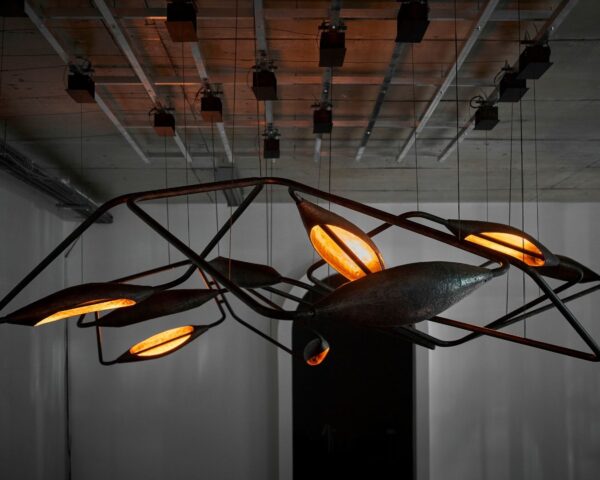
Amphora. Photo Credits: Sean Gibson
4. Amphora was designed as a modular system with articulated joints, which allows each pod to be positioned differently and direct light in multiple ways. Can you tell us a bit about this construction decision?
The modularity was essential for several reasons. First, every space we work with has unique architectural language, proportions, and lighting requirements. By creating a system where each pod can reticulate along all its joints, we’ve made the configurations essentially endless. The light source direction within each pod is also adjustable, allowing it to shine in almost any direction.
This flexibility serves our broader philosophy: lighting must respond to the space, not dictate to it. In practice, this means an Amphora installation in a Cape Town residence might be configured completely differently from one in Argentina, yet both feel perfectly integrated into their respective environments. The articulated joints allow us to create dynamic compositions that can emphasise vertical drama, horizontal spread, or clustered intimacy—whatever the space demands. It’s architecture for light.
5. You chose solid bronze as the main material, and your signature patinated finish means no two pieces are the same. What attracted you to bronze, and how do you develop the patina on each Amphora?
Bronze was a deliberate choice rooted in permanence and authenticity. It’s a material with ancient provenance—connecting directly to those original Greek amphora vessels—but it also possesses qualities essential for fine lighting: structural integrity, thermal properties that handle heat beautifully, and that extraordinary surface that develops character over time.
The patination process is where each Amphora truly becomes unique. Patina naturally forms on bronze and copper surfaces through atmospheric exposure, but we apply this in an accelerated, controlled manner. The process serves both aesthetic and preservation purposes, adding depth and character that contribute to each piece’s individuality. The colours can range from subtle browns and greens to vibrant blues and reds, with detailed patterns that evolve through the surface’s texture and the skill of our patina artist.
What’s beautiful about this approach is that it honours both craftsmanship and natural processes—every Amphora carries the mark of the artisan’s hand, making each installation truly one of a kind. No two patinas are identical; they respond to how the chemicals interact with the bronze, the humidity, the time of day the work was done. It’s lighting that carries its own story.
6. You’ve spoken about your commitment to local craftsmanship. Can you tell us how these artisans are involved in the production of Amphora?
Our commitment to local craftsmanship is fundamental to who we are. The patination process I mentioned requires exceptional skill—these are artisans who understand 2metal intimately, who can coax colors and patterns from bronze that feel both controlled and organic. Each patina artist brings their own sensibility to the work, which is why every Amphora has such distinctive character.
Beyond the patina artists, we work with metal fabricators, casters, and finishing specialists—all bringing generations of knowledge to contemporary applications. This isn’t just about supporting local economy, though that matters deeply to us. It’s about maintaining standards of quality that only come from human expertise and care. These artisans are collaborators in the truest sense, bringing their understanding of materials and processes that inform how we design.
In a world of mass production, this approach may seem inefficient, but it’s essential for the calibre of work we’re committed to. Our clients aren’t purchasing products; they’re investing in pieces that carry the touch of skilled hands and will remain timeless for generations.
7. What were the main challenges you faced while developing Amphora and how did you and your team overcome them?
The primary challenge was achieving that perfect balance between modularity and sculptural coherence. We needed joints that were robust enough to support the bronze pods at various angles, yet elegant enough not to interrupt the organic flow of the design. This required extensive prototyping—testing different joint mechanisms, load distributions, and electrical routing solutions.
The patination process also presented interesting challenges. Achieving consistency in the accelerated ageing process while celebrating individuality required developing strict protocols that still allowed for artistic interpretation. We had to ensure that every Amphora, regardless of when or by whom it was patinated, would meet our quality standards while maintaining that unique character.
Electrically, creating a system in which light sources could be positioned directionally within each pod while maintaining clean cable management through the articulated joints required innovative engineering. We worked through multiple iterations with our technical team, often going back to the drawing board when a solution compromised either functionality or aesthetics.
Ultimately, we overcame these challenges through iteration, collaboration between our designers and fabricators, and refusing to compromise on either artistic vision or technical excellence. Some solutions took months to refine, but that persistence is evident in the final piece.
8. Congratulations on winning the Chandeliers category at the LIT Lighting Design Awards! What does this recognition mean to you personally and to the One to One studio?
This recognition is profoundly meaningful on multiple levels. Personally, it validates a design philosophy I’ve been developing for over two decades—that lighting can and should serve human wellbeing, not just functional or aesthetic purposes. To have 3Amphora recognised on the global stage affirms that this biophilic approach resonates beyond our local context.
For the ONE TO ONE studio, this award represents a milestone in our journey from Cape Town to international recognition. We’re a South African studio competing on the world stage, and winning demonstrates that exceptional design isn’t geographically limited. It’s particularly meaningful given that we’ve always prioritised substance over flash—our work is about atmosphere, wellbeing, and connection to nature, not trends.
This recognition also honours our entire team: the designers, fabricators, patina artists, and everyone who contributes to our work. It validates our commitment to craftsmanship, to local production, to quality over quantity. And it positions us to have broader conversations about how lighting affects human health and happiness— conversations I believe the design industry needs to be having more seriously.

Amphora. Photo Credits: Sean Gibson
9. Looking ahead, what kinds of projects or directions are you excited to explore, and what advice would you give to aspiring lighting designers?
I’m particularly excited about the growing awareness of circadian rhythm lighting and its impact on human health. We’re moving beyond the idea that lighting is simply about visibility or aesthetics—it’s about wellness, about reconnecting people with the natural rhythms that modern life has disrupted. I see enormous potential in the hospitality and residential sectors for lighting that actively improves guests’ and residents’ well-being.
I’m also eager to explore larger-scale installations that push the boundaries of what experiential lighting can achieve. Following pieces like Stemma—the largest residential chandelier in the world—I want to continue creating installations that blur the line between lighting and sculpture, that become defining architectural elements.
For aspiring lighting designers, my advice is threefold: First, study natural light obsessively. Understand how it behaves throughout the day, across seasons, and in different geographies. Nature remains the ultimate teacher. Second, don’t be scared of the dark. Restraint in lighting often creates a more powerful atmosphere than overillumination. Learn when to withhold light, not just where to add it. Third, remember that you’re designing experiences, not products. Every lighting decision affects how people feel in a space—their mood, energy, even their sleep later that night. That’s a profound responsibility. Embrace it, and let it guide you toward work that genuinely serves human wellbeing alongside aesthetic ambition.
