Massimiliano Moro grew up in Lugano, Switzerland, and studied in Barcelona where he began with a sculpture’s academy and then a bachelor’s degree in art and design, followed by an intensive course in Light Design. He considers himself as a sculptor. His artistic focus is the act of viewing, all his sculptures, installations and designs circle around on the same theme: reveal the action of seeing to enhance its beauty and fragility.
Moro is always looking for new equilibriums between light and architecture through design and sculpture to research sight. He uses artificial light, the shadow as matter, the reflections, the movement, and their perception to generate new small and intimate worlds that open intangible spaces of reflection.
How did you first discover your passion for Lighting Design?
While exploring all the academic mediums to express myself in the art field, assignment after assignment I shifted more and more toward light and movement, realizing that it’s something I can work on hours and hours and discover always new things without getting tired. From there I searched for a way to share it to others, so that’s why I’m always shifting between art and light design.
Also most of our culture is based on what we see, so working with light is working with our understanding of the world: using artificial shadows is creating a difference between what we know and what we see and by this breaking the structures that sustain our beliefs. This really fascinates me, this power to change things without physically intervene on them.
Your winning project, Monstera Deliciosa is a site-specific project made for Palazzo di Napoli. Can you please explain to us, what was your creative journey?
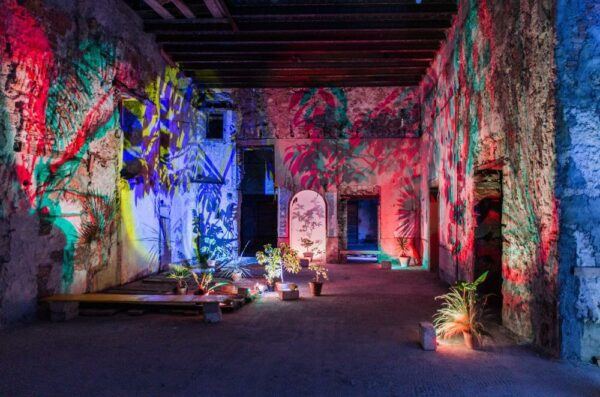
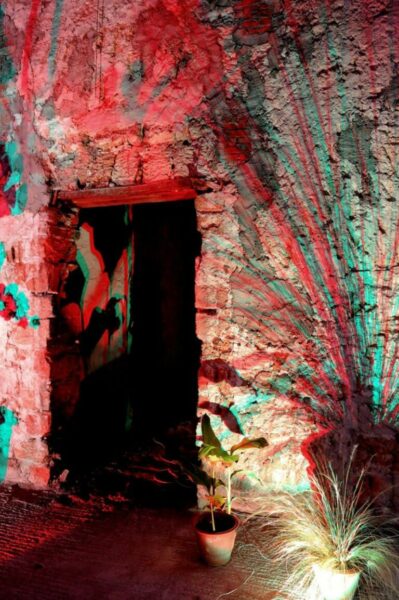
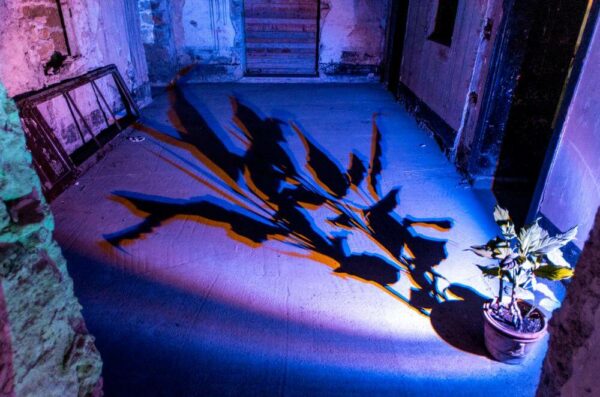
This exhibition took place in an abandoned palace in the center of Palermo, and in this case, I wanted to forget for a moment about the abandonment and focus on what was still there.
With light, I transformed the atmosphere making it lived again. With plants, I generated an immersive ambient where the human scale got mixed with the plants and their shadows, while other interventions accompanied you in discovering the beauty of the ancient architecture. It has been the start of a deep journey into the shape of shadows and how they can change the relationship we have with the space we move on.
What does this award mean to you, and how has it helped your career?
It meant a lot, as it was my first big solo exhibition, and being recognized by the jury gave me a big impulse for the next projects, knowing I was on an interesting path. Also, it gave me the economic possibility to create a custom heatsink for my lights, giving me a unique way to develop aesthetically my sculptures and designs. I am still using it for the majority of my projects!
What do you think are the biggest challenges and opportunities in your career now?
Right now, I’m “recalculating” as the GPS navigator would say… For many years I focused on portability and fast-moving the exhibitions, but now something has changed, mostly in the way we travel, so I’m investigating which way could be a new interesting strategy to show my work.
I don’t know where art is going to go, but I hope that this time we spent confined in our homes makes us more conscient about the little things that are around us. Allowing us to appreciate details of what is directly in contact with our bodies, to start work again in a way that soothes us instead of creating more contrast. To create art that fits more in a home and can be lived rather than stored in a collection. Or at least this is what I was doing, and I will continue even more convinced of it!
What are you working on now? What is in the pipeline for you?
I’m working with a colleague and friend to make an intervention in her exhibition in Barcelona, where our two artistic languages can dialogue (it involves plants again, after many years without using them as an artistic material). I am also finishing up the launch of Palmyr.art, a website that sells my line of limited editions sculptures that blur the limit between lamp and sculpture.
Apart from those specific things, I’m investigating the control of caustic reflections and how to take them to a more controlled level.
Moodable is an interactive light. The light quality can be variably adjusted by a simple and intuitive movement. The dynamic light can be adapted seamlessly to any situation and thus changes the mood in the room. By opening the luminaire, the light temperature, brightness and propagation angle can be varied.
The luminaire is based on a simple mechanism supplemented by a complex invisible digital component that creates a pleasant user experience. In contrast to other individually adjustable luminaires, the control works directly on the object. This creates a new way of interaction between user and object.
The mechanics are openly visible, so the function of the luminaire is self-explanatory due to its shape. The two halves of the luminaire balance themselves so that the luminaire can be stopped at any angle. The two halves of moodable are rotationally symmetrical, which makes production and installation easier.
The A-Light design team has a deep understanding of lighting’s contribution to architectural design intent and has been using this passion to develop beautiful and high-performance architectural lighting systems since 2001. Our Montreal (Canada) and Oceanside (California) based in-house industrial design teams are built on award-winning DNA. They follow a rigorous process to ensure the development of products that have superior optical engineering, contemporary design, unparalleled build quality. And, products are designed to be highly configurable to meet the needs of the architecture and design communities.
To us, successful product development is the result of a passionate and multi-disciplinary team that focuses on the ever-evolving needs of the environments we work in. To this end, our designers work closely with our production engineers as well as our sales and marketing teams to ensure the best quality and most relevant products possible. Along with the 2019 LIT Lighting Product of the Year award, we have been fortunate to have won many other awards over the years and this recognition motivates us to continue and lead in our exploration of new forms, functionality, and applications to meet the needs of the architectural design community.
Alfred R. Borden is the principal and the founder of The Lighting Practice (TLP) in the Philadelphia office in 1989 with an expansion to New York in 2018.
Al’s background in theatrical lighting taught him the importance of story and the powerful role light can play in how individuals experience an architectural space. He has taken on the major task of relighting many iconic buildings and landmarks, including the Empire State Building, Madison Square Garden, Philadelphia City Hall, Thomas Edison Memorial, and Trinity Centre.
He was part of the project team that completely replaced all vertical circulation within the Statue of Liberty’s stone pedestal and created life-safety egress paths across the pedestal’s terreplein and through the walls of Fort Wood.
In 2016, he designed the lighting system for the conversion of the historically landmarked Temple-Tifereth Israel into Case Western Reserve University’s Milton and Tamar Maltz Performing Arts Center. When the Empire State Building’s tower lighting became outdated, Al was tasked with changing the existing metal halide lighting system to color-changing LED.
From arts and entertainment to hospitality to transportation environments and more, Al’s designs have provided comfort, safety, and breathtaking beauty to hundreds of buildings and landscapes. To learn more…
Cue to Covid-19 health crisis, the LIT winner event has been postponed to 2021; therefore 2019 Grand Winners have received their Trophy by mail and sent a video acceptance speech.
July 2, 2020 (Los Angeles, CA) – The 3rd LIT Design Awards winner event originally planned for March 2020 is now officially postponed till next year due to the current global health crisis caused by Covid19. With over 100 attendees registered from 20 different countries, the safety of our winners and organizing team are of primary concern.
Therefore, we have decided to postpone the 2019 LIT Winners evening reception. This decision has not been made lightly, as it’s a key yearly event amongst the leading global Lighting and Lighting Product Designers.
The LIT 2019 Winners will be celebrated together with the LIT 2020 Winners at a future date and location which will be announced early 2021.
LIT Design Awards was assembled by the Farmani Group as the sister initiative of the IDA International Design Awards, which has been recognizing and celebrating smart and sustainable multidisciplinary design since 2007.
The Farmani Group, established in 1985, is responsible for many successful awards around the globe. Farmani Group organizes the International Design Awards (IDA), Architecture Masterprize (AMP), DNA Paris Design Awards, London International Creative Awards ( LICC), Prix de la Photographie in Paris, and the Annual Lucie Awards for Photography, which has emerged as one of the world’s most prestigious awards.
FOR IMMEDIATE RELEASE
Media Contact: press@farmanigroup.com
LIT Design Awards is open to submissions on a global level, accepting entries from lighting manufacturers, designers, and practices from all around the world.
The LIT Design Awards ™ was created to recognize the efforts of talented international lighting product designers and lighting implementers. We believe that lighting is both an art and a science, and it is one of the most important elements of design. LIT was envisioned to celebrate creativity and innovation in the fields of lighting products and applications.
Al Borden is a principal and the founder of The Lighting Practice. After years of designing temporary shows for a variety of theater groups and rock bands, Al founded ‘The Lighting Practice’. He opened the Philadelphia office in 1989 to create a place where like-minded designers could work in a collaborative environment dedicated to design excellence and client service. In 2018, Al spearheaded The Lighting Practice’s expansion to New York, becoming managing principal of TLP’s second location. Al was motivated to open the New York office to support the firm’s growth and provide a second home base for local and national clients.
The LIT 2019 Catalogue is now available! We are honoured to feature amazing lighting projects and designers’ work.
Our stunning cover is the “Trinity Centre in NY”, designed by 2019 Lifetime Achievement Winner Al Borden with The Lighting Practice. A complimentary copy is available for the 2019 Lighting Product Designers Category Winners and Lighting Designers Category Winners ( shipping is paid).
Shipping has been delayed due to the Covid-19 pandemic, please email us at team@litawards.com to receive your free coupon code and order online directly on our book store.
We would like to thank everyone who joined us for an exclusive evening celebrating the winners of the 2018 LIT Design Awards and the 2019 European Product Design Awards™ at the Private Members Club, Brody Studios Budapest on Thursday 3rd of October 2019.
Hidden in a pre-war mansion, Brody Studios is a cultural collision of a modern art gallery, artist studio, and private club that perfectly captures the vibrant creative spirit of Budapest.
Attendees met ePDA™ & LIT winners, as well as jury members and press representatives during the winner’s cocktail reception. Over the course of the evening, the event recognized and rewarded the excellence of ePDA™ and LIT Designers.