

In this interview, we speak with the interdisciplinary student team behind Flight into Shadow, an award-winning architectural lighting installation created for the Venice Architecture Biennale. Recognised in the Emerging category of Architectural Lighting Design at the LIT Lighting Design Awards, the project explores how light, shadow and material intelligence can help us adapt to heat-stressed urban environments, not through technology alone, but through spatial experience.
Developed by students Burak Bardakci, Miriam Haidn, Nico Karl, Jannick Lippert, Franziska Rieder, Sara Salamun, Jesse Voigt and Malik Yalniz, from the Deggendorf Institute of Technology (DIT), HFT Stuttgart and the University of Stuttgart, under the guidance of Prof. Sabine Wiesend and collaborating professors, Flight into Shadow was realised at Salone Verde Art & Social Club in Venice as part of the Keep Cool! Workshop for Cool Cities. At its centre is a bold architectural gesture, an artificial sun composed of individually controlled luminaires, paired with delicate mycelium structures that act as living filters, allowing shadow to emerge, soften and evolve.
Inspired by the Komorebi effect, the fleeting dance of sunlight through leaves, the installation transforms a natural phenomenon into a carefully choreographed environment. Visitors move between moments of glare and relief, exposure and refuge, experiencing light as a dynamic and emotional force. In the interview that follows, the team reflects on how the project came together across disciplines and institutions, the challenges of creating a controlled indoor sun, and why shadow may be one of the most powerful tools for designing comfort in a warming world.
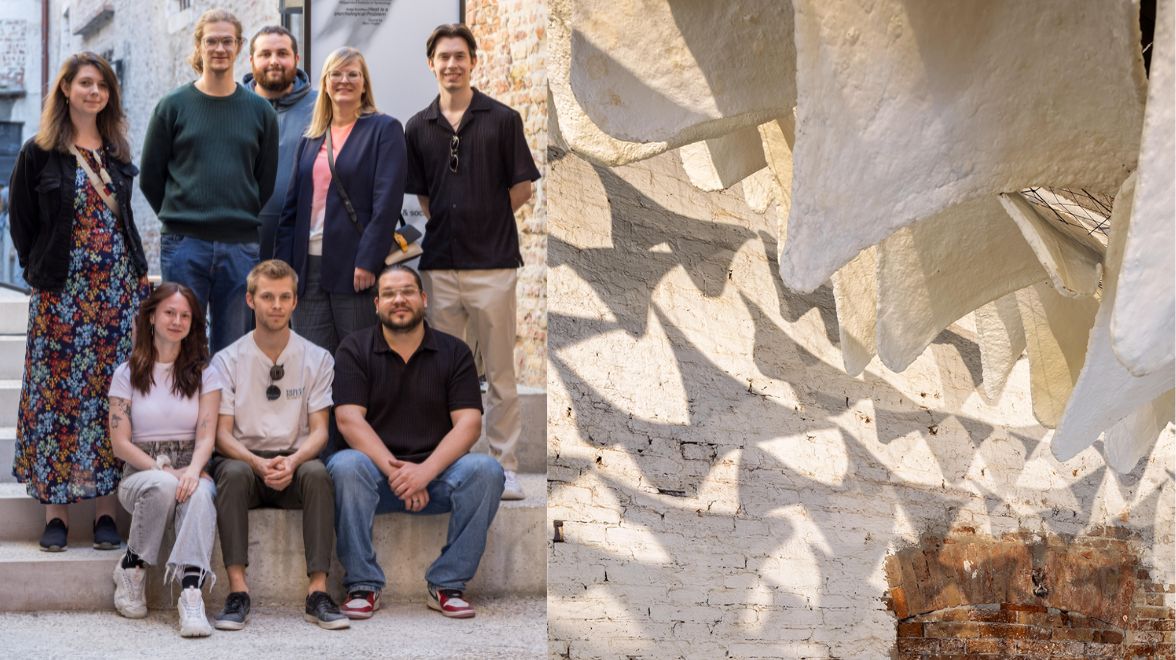
Flight into Shadow team // Flight into Shadow. Photo Credits: Jacopo La Forgia.
You came together as a group of students from different backgrounds and universities. How did you first meet, and what made you decide to work together on Flight into Shadow?
Flight into Shadow began with the idea of collaboration itself and the belief that complex challenges can be addressed more effectively when people from different backgrounds work together. With this mindset, Professors Diane Ziegler, Ralf Petersen, Martin Ostermann and Sabine Wiesend initiated the project, connecting multiple disciplines and institutions from the outset. The project was closely linked to a real spatial context. Salone Verde, with its owners Anna and Ralf Petersen, offered not only a venue but an active collaborative environment in which Flight into Shadow could be developed as part of the Keep Cool! Workshop for Cool Cities was realised as a full-scale installation.
Through the specialised elective course Architecture Biennale 2025, Prof. Sabine Wiesend, Professor for Lighting Technology and Lighting Design, offered master students of Media Technology at the Deggendorf Institute of Technology (DIT) the opportunity to join the Flight into Shadow team. This once-in-a-lifetime opportunity allowed us to actively contribute to a visionary project, ultimately exhibited in Venice during the world’s largest architecture exhibition, where light and mycelium merge into a stunning symbiosis, raising awareness for innovative approaches to urban overheating.
At the same time, the participating professors assembled student teams from their respective universities, officially launching the project. This combination of different universities, disciplines, and areas of expertise formed the foundation of Flight into Shadow and allowed it to develop into a truly interdisciplinary collaboration.
Our first meeting took place online at the beginning of February 2025, followed by a mycelium workshop at FUMA Lab and from there the project continued to evolve.
What is the story behind this project? What vision or moment of inspiration led you to explore heat, light, and shadow in this way
Flight into Shadow grew out of the question of how we can live with heat and how we can adapt to it. This topic is central to the Architecture Biennale 2025 and also lightly aligns with themes explored in the German Pavilion. From the beginning, we wanted to approach this challenge with a positive perspective, focusing not on fear or limitation, but on creative and actionable solutions.
Rather than relying on energy-intensive technologies to create comfort, Flight into Shadow draws inspiration from cultures that have long lived with high temperatures and developed intelligent, passive strategies of adaptation. In this context, shadow is not treated as a secondary by-product, but as an essential design tool capable of shaping comfort, perception, and atmosphere.
The project connects directly to the Biennale’s overarching theme Intelligens. Natural. Artificial. Collective. By working with intense artificial light, living materials, and collaborative design processes, the installation explores how different forms of intelligence can shape our perception of heat, comfort, and space.
At Salone Verde, these principles are translated into an artistic spatial experience. Mycelium plays a central role not only as a natural, compostable material, but as a mediator between nature and the built environment. The mycelium panels form a sculptural canopy of shade beneath an intense artificial sun, creating spaces of relief.
The vision behind the project was to make heat physically and emotionally perceptible and to show, through direct experience, how light and shadow shape our sense of comfort. By placing visitors between exposure and refuge, Flight into Shadow invites a more conscious awareness of how we might adapt to heat in everyday spaces.
The project “invites the Sun indoors” and creates a controlled solar experience, independent of the real weather outside. In practical terms, how did you achieve that?
To create a controlled “indoor sun” independent of outdoor weather conditions, we focused on luminous intensity, spatial form, dynamics and the deliberate creation of shadows.
For the sunball, we used 26 luminaires, each delivering approximately 20.000 lumens. Combined, their output allowed us to achieve an extremely high level of illumination – naturally still far below that of the real sun, but sufficient to create an intense and convincing solar presence within the space. The light is deliberately directed, allowing it to spread into the room and interact with surfaces and the mycelium cloud to generate dynamic shadow patterns. At the same time, it is not as narrowly focused as the real sun, enabling the light to shape the atmosphere rather than forming a single, sharply defined beam.
Equally important was the physical form of the “indoor sun”. A significant part of the process involved developing a structure that could combine all 26 luminaires into a spherical configuration that visually and spatially evokes the sun. Each luminaire was assigned a precise position to ensure optimal light distribution and to orchestrate the formation of layered shadows. The supporting structure, along with the entire lighting control system and cabling, was custom-designed and manufactured by us at our university, enabling the creation of dynamic scenes and a continuously evolving interplay of light and shadow throughout the installation.
You describe a “choreography of light” that shifts between harsh exposure and gentle refuge. How did you design and programme this sequence of moods and scenes?
The choreography of light was developed through a combination of simulation-based planning and on-site adaptation. We began with virtual lighting simulations to define where visitors should be deliberately exposed to intense brightness and where zones of shadow would provide visual relief. For each scene, we evaluated different parameters such as contrast and intensity to ensure a carefully balanced spatial experience.
Next, we designed a sequence of distinct lighting scenes and simulated each individually to verify that exposure levels were maintained throughout the transitions. Since the final geometry of the mycelium cloud could not be fully predicted until installation in Venice, a significant part of the design process took place on site. This required extensive fine-tuning to respond to the actual spatial conditions and to make the experience truly site-specific.
During on-site programming, we ensured that the interaction between space, light, and shadow was constantly evolving, allowing visitors to continuously discover new shadow situations. Particular attention was paid to the timing and interaction of individual luminaires, carefully considering when each light dims or intensifies and how these changes influence the perception and atmosphere.
The entire lighting choreography was programmed using Bluetooth-controlled systems. In addition to the luminaires, a hazer was integrated to create atmospheric light beams, allowing the light to become visible in space and emphasising the contrast between intense exposure and shadow through pronounced god rays.
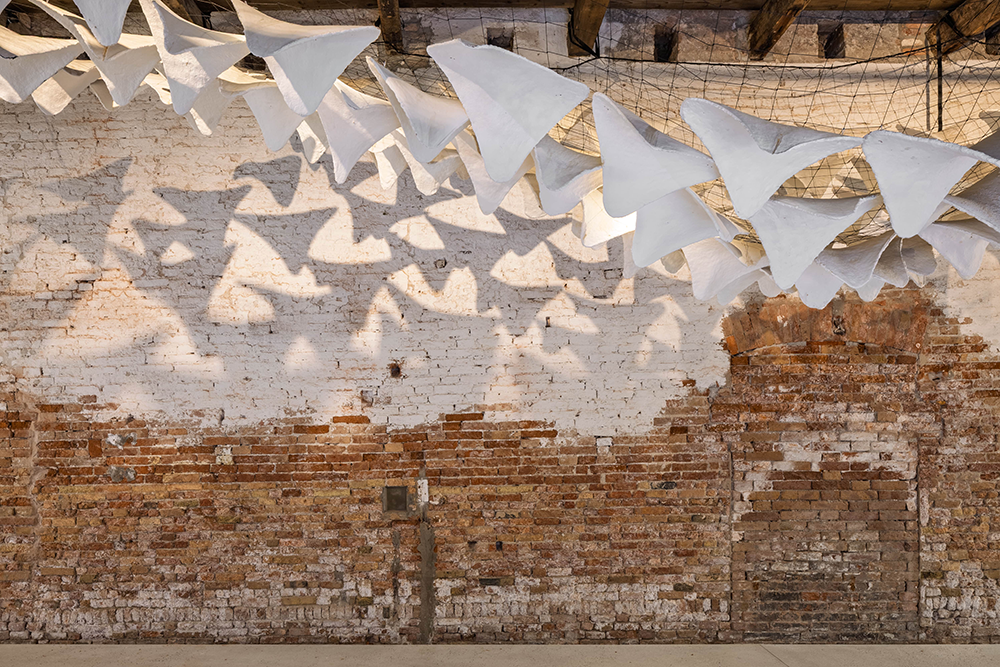
Flight into Shadow. Photo Credits: Jacopo La Forgia.
The installation brings together a powerful artificial sun and delicate mycelium structures. Why did you choose mycelium and these particular lighting elements, and how does each one help you express your vision?
The choice of the artificial sun and the mycelium was guided by the Biennale’s overarching theme Intelligens. Natural. Artificial. Collective.
The artificial sun represents artificial intelligence in a broader sense: a human-made system that generates intense light and heat through technical means. It stands for control, optimisation, and technological intervention, and introduces an intentionally industrial contrast through its scale and appearance. Digital simulation and control play a key role in its configuration and operation, confronting visitors with an exaggerated condition that reflects how we often respond to environmental challenges through engineered and highly controlled solutions.
The mycelium represents natural intelligence. As a living, fast-growing material, it adapts to its environment and forms networks rather than isolated elements. Suspended as a canopy, it creates shade and relief through its inherent material behaviour, without relying on active or energy-intensive systems.
The collective intelligence of the project lies in the collaboration itself. Flight into Shadow was developed through the cooperation of HFT Stuttgart Interior Architecture, Deggendorf Institute of Technology (DIT), and the University of Stuttgart IBK2. Each institution contributed distinct expertise, and the project could only emerge through this shared process.
Together, these elements help express our central vision. The artificial sun makes heat and exposure tangible, pushing visitors into an uncomfortable, heightened state of awareness. The mycelium responds to this condition by offering shadow, calm, and spatial relief, demonstrating how natural systems can counterbalance extreme environments. The collaboration between the three universities reflects the idea that responding to complex challenges like climate and urban heat requires shared knowledge and collective effort. In this way, the installation translates different forms of intelligence into a direct, physical experience.
When a visitor steps into the installation for the first time, what do you hope they feel, notice, and take away from the experience?
When visitors step into the installation, we want the first reaction to be physical rather than intellectual. The light is deliberately intense and uncomfortable, similar to the feeling of looking into the sun. That moment of glare is meant to trigger an immediate sense of heat and strain, reflecting how increasingly extreme sunlight already affects our everyday lives and how this will only intensify with climate change.
As people move through the space, they quickly discover the opposite experience: stepping into the shadow brings instant relief. The glare softens, the heat feels less oppressive, and the body can relax. This contrast is intentional; it shows how even small, thoughtful interventions can make harsh conditions more bearable.
One of the key ideas we want visitors to take away is that comfort does not require massive technological solutions, even with a powerful “sun” dominating the room.
The installation is not meant to be purely didactic. It is an artistic experience, and we want people to enjoy the aesthetics, the mood, and the emotional quality of the space, leaving with a feeling that is as memorable as it is reflective.
Your sustainability approach works on several levels, from compostable mycelium to reused luminaires and energy-efficient control. Can you walk us through the key decisions you made to keep the project as low-impact as possible?
Our sustainability strategy was built around a series of conscious, practical decisions rather than a single overarching gesture.
First, we deliberately selected mycelium as a key material. Mycelium is fast-growing, requires very few resources to produce, and is fully compostable at the end of its lifecycle, making it an ideal counterbalance to the more technical elements of the installation, both environmentally and conceptually. At the same time, mycelium is still an experimental material under active research and does not yet have an established market application. Within this project, it was explored in a three-dimensional, spatial form, contributing to ongoing research and helping to further develop its potential as a building material.
Second, we chose to work with already existing luminaires, which were kindly donated, instead of purchasing new ones. By reusing these fixtures, we were able to extend their lifecycle, avoid new production, and significantly reduce material waste and associated manufacturing emissions.
Third, the entire supporting structure was designed and fabricated locally in Deggendorf by the team itself. Producing the construction on site allowed us to minimise transportation distances, reduce emissions and costs, and maintain full control over material use and assembly.
In addition to these material choices, we paid close attention to energy use through efficient LED technology and intelligent control systems, ensuring that light output, scenes, and operating times were precisely managed and never excessive.
Together, these decisions allowed us to keep the project’s overall environmental impact as low as possible while still achieving a strong spatial and emotional effect.
What were the biggest challenges you faced, and how did you solve them as a team?
The biggest challenge we faced was the extremely limited timeframe. The project was initiated at the end of December, and we had only about four months to develop, build, and realise a highly complex installation. For a project of this scale, this was far from ideal.
This challenge could only be overcome through strong teamwork, a shared commitment, and the dedicated support of our professor. Everyone was willing to take responsibility, adapt quickly, and push through moments of uncertainty and pressure. The guidance and encouragement from our professor, combined with the dedication of the entire team and even small contributions from external supporters, made it possible to meet the demanding schedule. There were phases where the workload and pace were genuinely intense, but the collective determination to create something meaningful and unique kept the project moving forward.
In the end, the result speaks for itself. Despite the tight schedule, the team managed to deliver a successful installation, which reinforced the value of collaboration, trust, persistence and shared dedication under real-world constraints.
Flight into Shadow has now received a LIT Lighting Design Award. Congratulations! What does this recognition mean to you, and how does it resonate with the message of the project?
Receiving the LIT Lighting Design Award means a great deal to all of us. It is a strong recognition of the hard work, commitment, and collaboration that went into the project. Beyond that, it confirms that the themes we are addressing resonate with a wider audience and that the project is able to communicate its message effectively through light and space.
In the context of Flight into Shadow, the award feels especially meaningful because the project is not only about highlighting challenges such as climate change and extreme conditions, but also about offering a sense of agency and optimism. The recognition reinforces our belief that design can open up more hopeful perspectives on the future and contribute to meaningful conversations about how we want to shape it.
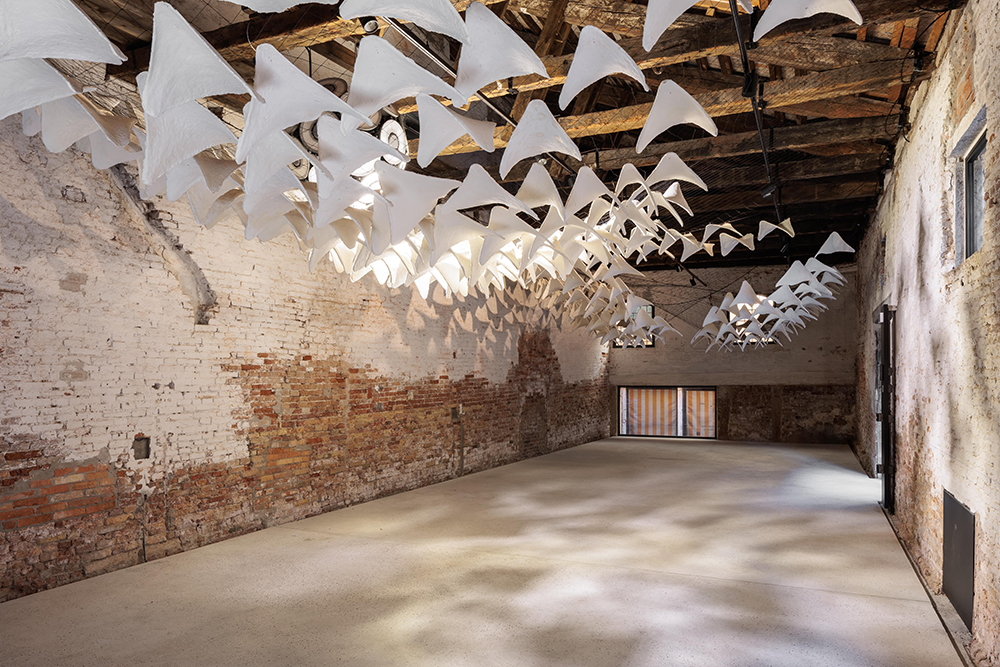
Flight into Shadow. Photo Credits: Jacopo La Forgia.
How do you see this experience influencing your future work, and what advice would you give to other students who hope to develop and exhibit projects at this level?
Like any major challenge, this experience taught us a great deal. We learned how to deal with unexpected problems, how to manage time under real pressure, and how to make decisions when conditions are far from ideal. One of the most important lessons was realising how much can be achieved when everyone contributes their strengths. Trust and reliability within the whole team proved essential; without them, even small challenges can quickly escalate into serious problems. Teamwork was crucial, and we also learned that a small amount of luck often plays a role in bringing complex projects together.
Looking ahead, this experience will strongly influence our future work. It has given us confidence to take on ambitious projects and to trust collaborative processes, even when timelines are tight and outcomes are uncertain.
Our advice to other students is simple: opportunities like this are rare, and when they come, you should take them, even if the timeframe is short and the challenge feels overwhelming. Projects at this scale are demanding, but they are also incredibly rewarding. Surround yourself with a committed and reliable team, trust the process, and be willing to learn along the way.
We would like to express our sincere thanks to the whole Team who made this project possible:
Lighting Design & Light Engineering
Deggendorf Institute of Technology (DIT)
Prof. Sabine Wiesend, Franziska Rieder, in collaboration with the Department Mechanical
Engineering Prof. Stefan Scherbarth
Mycelium Research, Production & Design
HFT Stuttgart, Interior Architecture
Prof. Diane Ziegler, Melissa Acker, Jürgen Aldinger, Romano Bianchi, Christoph Bihlmaier, Holger Bitterberg, Elisabeth Bokesch, Willi Mauch, and the students of HFT Stuttgart
University of Stuttgart, Institute of Building Construction, Building Technology and Design (IBK2)
Prof. Martin Ostermann, Eliza Biala, Mostafa Aboughaly, Piotr Baszynski, Andreas Schedler, Petr-Jiri Sebera, Simon Vogt, and the students of the University of Stuttgart
Salone Verde Art & Social Club
Anna Petersen and Prof. Ralf Petersen, curator Era Merkuri, Isotta Predieri with Predieri+Varini Architetti Associati
Their support, expertise, and trust gave us the opportunity to realise this project and quite literally let the shadows grow.